Sunday, October 21, 2018

Trump Administration Eyes Defining Transgender Out of Existence


Trump Administration Eyes Defining Transgender Out of Existence

From The New York Times


Protesting the toward gender in New York last year.Yana Paskova for The New York Times


WASHINGTON — The Trump administration is considering narrowly defining gender as a biological, immutable condition determined by genitalia at birth, the most drastic move yet in a governmentwide effort to roll back recognition and protections of transgender people under federal civil rights law.

A series of decisions by the Obama administration loosened the legal concept of gender in federal programs, including in education and health care, recognizing gender largely as an individual’s choice and not determined by the sex assigned at birth. The policy prompted fights over bathrooms, dormitories, single-sex programs and other arenas where gender was once seen as a simple concept. Conservatives, especially evangelical Christians, were incensed.

Now the Department of Health and Human Services is spearheading an effort to establish a legal definition of sex under Title IX, the federal civil rights law that bans gender discrimination in education programs that receive government financial assistance, according to a memo obtained by The New York Times.

The department argued in its memo that key government agencies needed to adopt an explicit and uniform definition of gender as determined “on a biological basis that is clear, grounded in science, objective and administrable.” The agency’s proposed definition would define sex as either male or female, unchangeable, and determined by the genitals that a person is born with, according to a draft reviewed by The Times. Any dispute about one’s sex would have to be clarified using genetic testing.

“Sex means a person’s status as male or female based on immutable biological traits identifiable by or before birth,” the department proposed in the memo, which was drafted and has been circulating since last spring. “The sex listed on a person’s birth certificate, as originally issued, shall constitute definitive proof of a person’s sex unless rebutted by reliable genetic evidence.”

The new definition would essentially eradicate federal recognition of the estimated 1.4 million Americans who have opted to recognize themselves — surgically or otherwise — as a gender other than the one they were born into.

“This takes a position that what the medical community understands about their patients — what people understand about themselves — is irrelevant because the government disagrees,” said Catherine E. Lhamon, who led the Education Department’s Office for Civil Rights in the Obama administration and helped write transgender guidance that is being undone.

The move would be the most significant of a series of maneuvers, large and small, to exclude the population from civil rights protections and roll back the Obama administration’s more fluid recognition of gender identity. The Trump administration has sought to bar transgender people from serving in the military and has legally challenged civil rights protections for the group embedded in the nation’s health care law.

Several agencies have withdrawn Obama-era policies that recognized gender identity in schools, prisons and homeless shelters. The administration even tried to remove questions about gender identity from a 2020 census survey and a national survey of elderly citizens.


For the last year, health and human services has privately argued that the term “sex” was never meant to include gender identity or even homosexuality, and that the lack of clarity allowed the Obama administration to wrongfully extend civil rights protections to people who should not have them.


Roger Severino, now at the Department of Health and Human Services, was among the conservatives who blanched at the Obama administration’s expansion of sex to include gender identity.Aaron P. Bernstein/Getty Images


Roger Severino, the director of the Office for Civil Rights at the Department of Health and Human Services, declined to answer detailed questions about the memo or his role in interagency discussions about how to revise the definition of sex under Title IX.

But officials at the Department of Health and Human Services confirmed that their push to limit the definition of sex for the purpose of federal civil rights laws resulted from their own reading of the laws and from a court decision.

Mr. Severino, while serving as the head of the DeVos Center for Religion and Civil Society at the Heritage Foundation, was among the conservatives who blanched at the Obama administration’s expansion of sex to include gender identity, which he called “radical gender ideology.”

In one commentary piece, he called the policies a “culmination of a series of unilateral, and frequently lawless, administration attempts to impose a new definition of what it means to be a man or a woman on the entire nation.”

“Transgender people are frightened,” said Sarah Warbelow, the legal director of the Human Rights Campaign, which presses for the rights of lesbian, gay, bisexual and transgender people. “At every step where the administration has had the choice, they’ve opted to turn their back on transgender people.”

The Department of Health and Human Services has called on the “Big Four” agencies that enforce some part of Title IX — the Departments of Education, Justice, Health and Human Services, and Labor — to adopt its definition in regulations that will establish uniformity in the government and increase the likelihood that courts will accept it.

The definition is integral to two proposed rules currently under review at the White House: One from the Education Department deals with complaints of sex discrimination at schools and colleges receiving federal financial assistance; the other, from health and human services, deals with health programs and activities that receive federal funds or subsidies. Both regulations are expected to be released this fall, and would then be open for public comment, typically for 60 days. The agencies would consider the comments before issuing final rules with the force of law — both of which could include the new gender definition.

Civil rights groups have been meeting with federal officials in recent weeks to argue against the proposed definition, which has divided career and political appointees across the administration. Some officials hope that health and human services will at least rein in the most extreme parts, such as the call for genetic testing to determine sex.

After more than a year of discussions, health and human services is preparing to formally present the new definition to the Justice Department before the end of the year, Trump administration officials say. If the Justice Department decides that the change is legal, the new definition can be approved and enforced in Title IX statutes, and across government agencies.

The Justice Department declined to comment on the draft health and human services proposal. The Justice Department has not yet been asked to render a formal legal opinion, according to an official there who was not authorized to speak about the process.

But Attorney General Jeff Sessions’s previous decisions on transgender protections have given civil rights advocates little hope that the department will prevent the new definition from being enforced. The proposal appears consistent with the position he took in an October 2017 memo sent to agencies clarifying that the civil rights law that prohibits job discrimination does not cover “gender identity, per se.”


Harper Jean Tobin, the policy director of the National Center for Transgender Equality, an advocacy group, called the maneuvering “an extremely aggressive legal position that is inconsistent with dozens of federal court decisions.”


A transgender flag outside a bar in Brooklyn. The agency’s proposed definition would define sex as either male or female, unchangeable, and determined by the genitals that a person is born with.Annie Tritt for The New York Times

Health and human services officials said they were only abiding by court orders, referring to the rulings of Judge Reed O’Connor of the Federal District Court in Fort Worth, Tex., a George W. Bush appointee who has held that “Congress did not understand ‘sex’ to include ‘gender identity.’”

A 2016 ruling by Judge O’Connor concerned a rule that was adopted to carry out a civil rights statute embedded in the Affordable Care Act. The provision prohibits discrimination based on race, color, national origin, sex, age or disability in “any health program or activity” that receives federal financial assistance.

But in recent discussions with the administration, civil rights groups, including Lambda Legal, have pointed to other court cases. In a legal memo presented to the administration, a coalition of civil rights groups wrote, “The overwhelming majority of courts to address the question since the most relevant Supreme Court precedent in 1998 have held that antitransgender bias constitutes sex discrimination under federal laws like Title IX.”

Indeed, the health and human services proposal was prompted, in part, by pro-transgender court decisions in the last year that upheld the Obama administration’s position.

In their memo, health and human services officials wrote that “courts and plaintiffs are racing to get decisions” ahead of any rule-making, because of the lack of a stand-alone definition.

“Courts and the previous administration took advantage of this circumstance to include gender identity and sexual orientation in a multitude of agencies, and under a multitude of laws,” the memo states. Doing so “led to confusion and negative policy consequences in health care, education and other federal contexts.”


The narrower definition would be acutely felt in schools and their most visible battlegrounds: locker rooms and bathrooms.

One of the Trump administration’s first decisive policy acts was the rescission by the Education and Justice Departments of Obama-era guidelines that protected transgender students who wanted to use bathrooms that correspond to their gender identity.

Since the guidance was rescinded, the Education Department’s Office for Civil Rights has halted and dismissed discrimination cases filed by transgender students over access to school facilities. A restrictive governmentwide definition would cement the Education Department’s current approach.

But it would also raise new questions.

The department would have to decide what documentation schools would be required to collect to determine or codify gender. Title IX applies to a number of educational experiences, such as sports and single-sex classes or programs where gender identity has come into play. The department has said it will continue to open cases where transgender students face discrimination, bullying and harassment, and investigate gender-based harassment as “unwelcome conduct based on a student’s sex” or “harassing conduct based on a student’s failure to conform to sex stereotypes.”

The Education Department did not respond to an inquiry about the health and human services proposal.

Ms. Lhamon of the Obama Education Department said the proposed definition “quite simply negates the humanity of people.”

Wednesday, October 17, 2018

“White Fragility”

A Sociologist Examines the “White Fragility” That Prevents White Americans from Confronting Racism


The New Yorker


In more than twenty years of running diversity-training and cultural-competency workshops for American companies, the academic and educator Robin DiAngelo has noticed that white people are sensationally, histrionically bad at discussing racism. Like waves on sand, their reactions form predictable patterns: they will insist that they “were taught to treat everyone the same,” that they are “color-blind,” that they “don’t care if you are pink, purple, or polka-dotted.” They will point to friends and family members of color, a history of civil-rights activism, or a more “salient” issue, such as class or gender. They will shout and bluster. They will cry. In 2011, DiAngelo coined the term “white fragility” to describe the disbelieving defensiveness that white people exhibit when their ideas about race and racism are challenged—and particularly when they feel implicated in white supremacy. Why, she wondered, did her feedback prompt such resistance, as if the mention of racism were more offensive than the fact or practice of it?

In a new book, “White Fragility,” DiAngelo attempts to explicate the phenomenon of white people’s paper-thin skin. She argues that our largely segregated society is set up to insulate whites from racial discomfort, so that they fall to pieces at the first application of stress—such as, for instance, when someone suggests that “flesh-toned” may not be an appropriate name for a beige crayon. Unused to unpleasantness (more than unused to it—racial hierarchies tell white people that they are entitled to peace and deference), they lack the “racial stamina” to engage in difficult conversations. This leads them to respond to “racial triggers”—the show “Dear White People,” the term “wypipo”—with “emotions such as anger, fear and guilt,” DiAngelo writes, “and behaviors such as argumentation, silence, and withdrawal from the stress-inducing situation.”

DiAngelo, who is white, emphasizes that the stances that make up white fragility are not merely irrational. (Or even comical, though some of her anecdotes—participants in a voluntary anti-racism workshop dissolving with umbrage at any talk of racism—simmer with perverse humor. “I have found that the only way to give feedback without triggering white fragility is not to give it at all,” she remarks wryly.) These splutterings “work,” DiAngelo explains, “to reinstate white equilibrium as they repel the challenge, return our racial comfort, and maintain our dominance within the racial hierarchy.” She finds that the social costs for a black person in awakening the sleeping dragon of white fragility often prove so high that many black people don’t risk pointing out discrimination when they see it. And the expectation of “white solidarity”—white people will forbear from correcting each other’s racial missteps, to preserve the peace—makes genuine allyship elusive. White fragility holds racism in place.

DiAngelo addresses her book mostly to white people, and she reserves her harshest criticism for white liberals like herself (and like me), whom she sees as refusing to acknowledge their own participation in racist systems. “I believe,” she writes, “that white progressives cause the most daily damage to people of color.” Not only do these people fail to see their complicity, but they take a self-serving approach to ongoing anti-racism efforts: “To the degree that white progressives think we have arrived, we will put our energy into making sure that others see us as having arrived.” Even the racial beliefs and responses that feel authentic or well-intentioned have likely been programmed by white supremacy, to perpetuate white supremacy. Whites profit off of an American political and economic system that showers advantages on racial “winners” and oppresses racial “losers.” Yet, DiAngelo writes, white people cling to the notion of racial innocence, a form of weaponized denial that positions black people as the “havers” of race and the guardians of racial knowledge. Whiteness, on the other hand, scans as invisible, default, a form of racelessness. “Color blindness,” the argument that race shouldn’t matter, prevents us from grappling with how it does.

Much of “White Fragility” is dedicated to pulling back the veil on these so-called pillars of whiteness: assumptions that prop up racist beliefs without our realizing it. Such ideologies include individualism, or the distinctly white-American dream that one writes one’s own destiny, and objectivity, the confidence that one can free oneself entirely from bias. As a sociologist trained in mapping group patterns, DiAngelo can’t help but regard both precepts as naïve (at best) and arrogant (at worst). To be perceived as an individual, to not be associated with anything negative because of your skin color, she notes, is a privilege largely afforded to white people; although most school shooters, domestic terrorists, and rapists in the United States are white, it is rare to see a white man on the street reduced to a stereotype. Likewise, people of color often endure having their views attributed to their racial identities; the luxury of impartiality is denied them. (In outlining these discrepancies, DiAngelo draws heavily on the words of black writers and scholars—Ta-Nehisi Coates, Toni Morrison, Ijeoma Oluo, Cheryl Harris—although, perhaps surprisingly, she incorporates few present-day interviews with people of color.)

In DiAngelo’s almost epidemiological vision of white racism, our minds and bodies play host to a pathogen that seeks to replicate itself, sickening us in the process. Like a mutating virus, racism shape-shifts in order to stay alive; when its explicit expression becomes taboo, it hides in coded language. Nor does prejudice disappear when people decide that they will no longer tolerate it. It just looks for ways to avoid detection. “The most effective adaptation of racism over time,” DiAngelo claims, “is the idea that racism is conscious bias held by mean people.” This “good/bad binary,” positing a world of evil racists and compassionate non-racists, is itself a racist construct, eliding systemic injustice and imbuing racism with such shattering moral meaning that white people, especially progressives, cannot bear to face their collusion in it. (Pause on that, white reader. You may have subconsciously developed your strong negative feelings about racism in order to escape having to help dismantle it.) As an ethical thinker, DiAngelo belongs to the utilitarian school, which places less importance on attitudes than on the ways in which attitudes cause harm. Unpacking the fantasy of black men as dangerous and violent, she does not simply fact-check it; she shows the myth’s usefulness to white people—to obscure the historical brutality against African-Americans, and to justify continued abuse.

DiAngelo sometimes adopts a soothing, conciliatory tone toward white readers, as if she were appeasing a child on the verge of a tantrum. “If your definition of a racist is someone who holds conscious dislike of people because of race, then I agree that it is offensive for me to suggest that you are racist when I don’t know you,” she writes. “I also agree that if this is your definition of racism, and you are against racism, then you are not racist. Now breathe. I am not using this definition of racism, and I am not saying that you are immoral. If you can remain open as I lay out my argument, it should soon begin to make sense.” One has the grim hunch that such an approach has been honed over years of placating red-faced white people, workshop participants leaping at any excuse to discount their instructor. DiAngelo, for all the outrageousness she documents, never comes across as anything other than preternaturally calm, patient, and lucid, issuing prescriptions for a better world as if from beneath a blanket of Ativan. Her almost motorized equipoise clarifies the book’s stakes: she cannot afford to lose us, who are so easily lost.

Self-righteousness becomes a seductive complement to “White Fragility,” as gin is to a mystery novel. (“I would never,” I thought, when DiAngelo described the conversation in which her friend dismissed a predominantly black neighborhood as “bad,” unsafe.) Yet the point of the book is that each white person believes herself the exception, one of very few souls magically exempt from a lifetime of racist conditioning. DiAngelo sets aside a whole chapter for the self-indulgent tears of white women, so distraught at the country’s legacy of racist terrorism that they force people of color to drink from the firehose of their feelings about it.

The book is more diagnostic than solutions-oriented, and the guidelines it offers toward the end—listen, don’t center yourself, get educated, think about your responses and what role they play—won’t shock any nervous systems. The value in “White Fragility” lies in its methodical, irrefutable exposure of racism in thought and action, and its call for humility and vigilance. Combatting one’s inner voices of racial prejudice, sneaky and, at times, irresistibly persuasive, is a life’s work. For all the paranoid American theories of being “red-pilled,” of awakening into a many-tentacled liberal/feminist/Jewish conspiracy, the most corrosive force, the ectoplasm infusing itself invisibly through media and culture and politics, is white supremacy.

That’s from a white progressive perspective, of course. The conspiracy of racism is hardly invisible to people of color, many of whom, I suspect, could have written this book in their sleep.

Tuesday, October 16, 2018

Elizabeth Warren Falls for Trump’s Trap


Elizabeth Warren Falls for Trump’s Trap—and Promotes Insidious Ideas About Race and DNA

Massha Gessen The New Yorker


The Trumpian taunt is a trap. A video released by Senator Elizabeth Warren, of Massachusetts, on Monday demonstrates just how it works.

What Warren intended to demonstrate is that she has Native American ancestry, and that she has a genetic test to prove it. She did this because Donald Trump has repeatedly accused her of lying about her heritage and, during a rally last summer, even promised to donate a million dollars to the charity of Warren’s choice if she could produce a genetic test that verified her claims.

In addition to the video, Warren posted a geneticist’s report on her DNA test. It’s worth noting what the report said: not very much. The author of the report—the Stanford University professor Carlos Bustamante, who consults for several DNA-testing services—identifies Warren as a person of European ancestry and writes that more than ninety-five per cent of her genome comes from Europe. A small portion, he writes, appears to point to a distant Native American ancestor, between six and ten generations ago.

It is important to understand that, contrary to the impression created by television and online advertising, a DNA test can never provide definitive information about one’s heritage. Ancestry-testing services deal in correlations: they collect data on genetic markers on the one hand and personal narratives on the other. If all or most of the people who identify as, say, Ashkenazi Jewish have a certain genetic marker, the database will learn to recognize the marker as “Ashkenazi Jewish”; chances are, most Palestinians in this world would have this marker as well, but as long as none of them has used this particular service, the marker will be known as “Jewish.”

When ancestry-testing services first appeared in this country a dozen years ago, they found that Americans, at least, tended to have fairly reliable stories about their family heritage. An exception were people who had a family story, usually passed down through a number of generations, of having Native American blood—most often, the legend said that they were Cherokee. For years, geneticists had trouble finding any corroboration for this claim. It’s possible that their tests weren’t sensitive enough, or that they were looking in the wrong place; it is also possible that family stories of having descended from Native Americans were particularly unreliable. Over time, the tests learned to detect ever more subtle signs and patterns, as Warren’s case appears to have done.

Trump’s frequent attacks on Warren have contained several transparent messages. She looks like a white woman but she claims to be Native American, and therefore she is a liar, says one. In the Trumpian universe, lying is always motivated by profit; therefore, Warren must be lying because she wants the benefits of being Native American, as these must have to do with education and employment. Trump conjures so many familiar irritants: a woman, a cheater, someone nonwhite, and affirmative action itself. He has been demanding the DNA test the same way he used to demand that President Obama produce his birth certificate.

The senator’s video is carefully worded. Warren says that she is laying no claim to citizenship in a tribe. She frames her understanding of her ancestry in terms of experience, though this experience seems fairly well removed: the defining event in Warren’s family was her father’s family’s disapproval of his marriage to her future mother; Warren says that it was the Native American heritage that made her father’s family suspicious. Talking heads from the universities where Warren was employed assure the audience that she has never used her heritage to advance professionally.

Visually and dramatically, though, the video suggests a different framing. We see Warren’s three brothers, who appear darker than she is. It seems that we might be seeing them not only because they are Republicans, as they say, but also because they look more like what we imagine Native Americans should look like. A female cousin is identified as a citizen of the Cherokee Nation. And the centerpiece of the clip is the DNA-test reveal: the professor confirms that the senator has Native American blood.

Within hours of the appearance of the video, Kim TallBear, a professor at the University of Alberta and a leading expert on the use of DNA testing in tribal communities, posted a statement. Sharply critical of Warren’s behavior and publicity surrounding the test, she pointed out that tribal governments have developed an approach for determining who belongs to a tribe that is explicitly not based on the results of DNA tests. Still, she wrote, Warren and her staff “know very well that the broader US public will understand a DNA test to be a true indication of Elizabeth Warren’s right to claim Native American identity in some way.”

Just what’s wrong with that assumption is laid out in an essay published on ThinkProgress last year by the indigenous activist Rebecca Nagle: Warren, Nagle wrote, is positioning herself as a representative of people whose experience she does not share or understand. Warren has been criticized for failing to meet with Native American leaders, and she has garnered no praise from them for her legislative work (though she has recently signed on to several bills that address indigenous issues). Her visibility as an ostensible Native American exacerbates the invisibility of people who have grown up and live as Native Americans. “As contemporary Native Americans, we live in the space between Donald Trump and Elizabeth Warren, between the stereotypes that were created to excuse the wholesale slaughter of our people and the stereotypes that were created to excuse the wholesale appropriation of our identity and cultures,” Nagle wrote. “The Trumps and Warrens of the world leave very little space for us to exist—which, when you understand the history of the United States, makes perfect sense.”

Warren ended up providing one of the clearest examples yet of how Trumpian rhetoric shifts the political conversation. The woman who is hoping to become the most progressive Democratic nominee in generations is not merely letting herself get jerked around by a Trumpian taunt. She is also reinforcing one of the most insidious ways in which Americans talk about race: as though it were a measurable biological category, one that, in some cases, can be determined by a single drop of blood. Genetic-test evidence is circular: if everyone who claims to be X has a particular genetic marker, then everyone with the marker is likely to be X. This would be flawed reasoning in any area, but what makes it bad science is that it reinforces the belief in the existence of X—in this case, race as a biological category. Warren’s video will hardly convince a Trump voter, who will see only a woman who feels that she has to prove something. Trump himself has already walked back his promise of a million-dollar charity donation. Warren, meanwhile, has allowed herself to be dragged into a conversation based on an outdated, harmful concept of racial blood—one that promotes the pernicious idea of biological differences among people—and she has pulled her supporters right along with her.

Monday, October 08, 2018

Statement from Taylor Swift

Statement from Taylor Swift 


I’m writing this post about the upcoming mid term elections on November 6th, in which I’ll be voting in the state of Tennessee. In the past I’ve been reluctant to publicly voice my political opinions, but due to several events in my life and in the world in the past two years, I feel very differently about that now. I always have and always will cast my vote based on which candidate will protect and fight for the human rights I believe we all deserve in this country. I believe in the fight for LGBTQ rights, and that any form of discrimination based on sexual orientation or gender is WRONG. I believe that the systemic racism we still see in this country towards people of color is terrifying, sickening and prevalent. 

I cannot vote for someone who will not be willing to fight for dignity for ALL Americans, no matter their skin color, gender or who they love. Running for Senate in the state of Tennessee is a woman named Marsha Blackburn. As much as I have in the past and would like to continue voting for women in office, I cannot support Marsha Blackburn. Her voting record in Congress appalls and terrifies me. She voted against equal pay for women. She voted against the Reauthorization of the Violence Against Women Act, which attempts to protect women from domestic violence, stalking, and date rape. She believes businesses have a right to refuse service to gay couples. She also believes they should not have the right to marry. These are not MY Tennessee values. 

I will be voting for Phil Bredesen for Senate and Jim Cooper for House of Representatives. Please, please educate yourself on the candidates running in your state and vote based on who most closely represents your values. For a lot of us, we may never find a candidate or party with whom we agree 100% on every issue, but we have to vote anyway.

So many intelligent, thoughtful, self-possessed people have turned 18 in the past two years and now have the right and privilege to make their vote count. But first you need to register, which is quick and easy to do. October 9th is the LAST DAY to register to vote in the state of TN. Go to vote.org and you can find all the info. Happy Voting

! 🗳😃🌈

Saturday, October 06, 2018

Resisting the Juristocracy


Resisting the Juristocracy


Samuel Moyn Boston Review

That Democrats fought the nomination of Brett Kavanaugh to the Supreme Court tooth and nail was entirely understandable, especially after Christine Blasey Ford’s allegations of sexual assault. With yesterday's events making Kavanaugh’s confirmation a near certainty today, everything now depends on how liberals and progressives decide to respond to the hard fact of right-wing control of the imperial judiciary. The answer is obvious: the United States is supposed to be a democracy, not an empire.


Affirmative action will be the first to go, with Justice Kavanaugh’s vote. A federal abortion right is also on the chopping block, with the main question remaining whether it will die in a single blow or a succession of smaller ones. The First Amendment will continue to be “weaponized” in the service of economic power, as Justice Elena Kagan put it last term. And the rest of constitutional law will turn into a defense of business interests and corporate might the likes of which the country has not seen in a century.

Which brings us back to Franklin Roosevelt’s mistake and our opportunity. The last time the court was converted into a tool of the rich and powerful against political majorities, Roosevelt tried to pack the court. Once the Democrats had finally gathered enough political will to stand the Court down, Roosevelt told the American people in March of 1937 that it was time to “save the Constitution from the Court and the Court from itself.”

But the Constitution is what got us here, along with longstanding interpretations of it such as Marbury v. Madison that transform popular rule into elite rule and democracy into juristocracy. Only because of the constitution do Democrats have to battle in a political system in which minorities take the presidency—twice in our lifetime. Only because of a cult of the higher judiciary do Democrats find themselves facing an all-powerful institution set to impose its will on a majority of Americans who would decide things differently.

The mythology of constitutional law dies hard.

And only because everyone knows that our system empowers constitutional judges to an extraordinary extent to make enormous policy decisions did Americans have to live through this latest national drama. Ironically, in this recent circus, the topic of the law itself disappeared as the lens focused successively on whether an assault occurred, what kind of investigation was proper, and if judicial “temperament” mattered. But then, prior confirmation battles had already pushed the actual legal views of nominees for the Supreme Court out of view.

The United States, Roberto Unger once wrote, is distinguished by “the single-minded focus upon the higher judges and their selection as the most important part of democratic politics.” This syndrome is reflected in the left as well as the right, and their choice over the decades “to obtain from judges, under the cover of improving interpretation, the advances popular politics fail to deliver.” Yet, in democracies, it is the people who are supposed to write their own laws. The limits of this longstanding judicial strategy were clear long before the left failed to block Kavanaugh, which means the only progressive move now is to reclaim democracy.

Consider the alternatives. In the face of a solid conservative majority for years to come, there is no doubt that many (both inside and outside the court) will look hopefully to Chief Justice John Roberts as the new swing vote and treat him, as they did Anthony Kennedy, as the new “centrist” to lure. But Roberts will defect far less regularly than Kennedy. For the more radical, it will seem tempting to complain—as Roosevelt did—of the betrayal of the Constitution. Yet the last constitutional revolution in the name of democracy, at the height of the New Deal, ended up setting the stage for fifty years of illicit judicial empowerment, in part because it merely pushed judges into promising to exercise restraint.

Progressives must embrace democracy and its risks if they want to avoid the stigma of judicial activism that still haunts them from the past.

In the face of an enemy Supreme Court, the only option is for progressives to begin work on a long-term plan to recast the role of fundamental law in our society for the sake of majority rule—disempowering the courts and angling, when they can, to redo our undemocratic constitution itself. This will require taking a few pages from the conservative playbook of the last generation. It is conservatives who stole the originally progressive talking point that we are experiencing “government by judiciary.” It is conservatives who convinced wide swathes of the American people that it is the left, not the right, that too routinely uses constitutional law to enact its policy preferences, no matter what the text says. The truth is the reverse, and progressives need to take back the charge they lost. To do so, they need to abandon their routine temptation to collude with the higher judiciary opportunistically. Progressives must embrace democracy and its risks if they want to avoid the stigma of judicial activism that still haunts them from the past.

Even though the right turned to judicial fiat far more frequently, liberals have taken a long time to give up on black-robed power to enact their preferences. This was most notable in decisions around the right to privacy and so-called “substantive due process.” In making such choices in cases ranging from Roe v. Wade (which secured abortion rights) to Obergefell v. Hodges (which legalized same-sex marriage), liberals entered an unholy alliance with Kennedy, Kavanaugh’s predecessor, to advance gay and women’s rights on a libertarian rationale—defending the free choice of individuals independent of state control—even though that rationale mostly serves business interests in most areas of law. The endangerment or even loss of precedents that the left cares about (such as Roe) is going to be a grievous blow, and no one should celebrate that outcome. But if it is going to happen anyway, then it is time to pivot to a democratic strategy to protect what we care about.

In the face of an enemy Supreme Court, progressives must recast the role of fundamental law in our society for the sake of majority rule.

Instead of terrorizing the court into moving through various court-packing schemes, it is a much better and bolder choice for the left to stand up for reforms that will take the last word from it. Jurisdiction-stripping statutes, tools to bar the judiciary from considering cases on certain topics such as abortion or affirmative action, are not clearly unconstitutional even under current legal doctrine. Indeed, the right has used such statutes for years to limit access to courts for immigrants and prisoners. Other changes in customs and precedent could also weaken judicial supremacy. For example, by choice under pressure or compulsion through law, the Supreme Court could evolve into an advisory body, especially when the justices disagree. Such steps would force progressives to take their case to the people to win majorities for their policies, including in places across the country they have given up for lost.

The United States still looks to the higher judiciary to act on behalf of the country’s principles and values, even when basic study proves that judges are partisan and that partisanship only increases when they are given the power to decide the highest stakes questions. The mythology of constitutional law dies hard. The notion that empowering judges would serve progressive outcomes is a flickering star that collapsed long ago, and it is long since time to accept the dying of the light. A legal culture less oriented to the judiciary and more to public service in obtaining and using democratic power in legislatures at all levels is the sole path to progress now. In fact, it always has been.

Monday, October 01, 2018

The Nightmare Of The Bones W B Yeats


The Nightmare Of The Bones

by Thomas O’Dwyer 3 Quarks Daily


Drumcliffe churchyard lies in the shadow of a flat-topped mountain, in the western Irish countryside of Sligo county, on the Atlantic coast. There are remains of a round tower and a carved Celtic high cross. It would be the perfect resting place for a country’s greatest poet – especially if the poet himself had chosen it.

“Bury me up there on the mountain, Roquebrune,” W.B. Yeats wrote to his wife Georgie before his death in France in 1939. “And then, after a year or so, after the newspapers have forgotten, plant me in Sligo.” The poet died in the Hôtel Idéal Séjour in the nearby town of Menton. His funeral cortege did indeed wind up a narrow hill to where Roquebrune cemetery looks out over the Mediterranean. But then came World War II, and the repatriation of the remains of one Irish poet was unlikely to be a priority for the Nazi-occupied French, or anybody else.

Seventy years ago this autumn, this last wish of Ireland’s first Nobel Prize winner was finally fulfilled. His family and proud countrymen brought him home for a splendid state funeral in his beloved Sligo. Yeats had written of his desired resting place before his death in one of his last poems, Under Ben Bulben. “Under bare Ben Bulben’s head / In Drumcliffe churchyard Yeats is laid, / An ancestor was rector there / Long years ago; a church stands near, / By the road an ancient Cross.” For good measure, he added an epitaph, the same one carved on his tombstone. In 1948, on a typical Irish September day, half sunshine and half rain, W.B. Yeats was laid in his chosen place to rest in peace forever.

Or was he?

Even then, there were whispers that the devious French had tricked the Irish and sent them a box of random bones unconnected to the national poet. Whoever lay in Drumcliffe churchyard, they said, it was not William Butler Yeats. The box of bones became a can of worms nobody wanted to open and the rumours faded. Irish schoolchildren recited Under Ben Bulban, and Sligo happily pinned itself to the world map of literary tourism.

The tales of any Irish hero were moulded into a mythology that fitted the cultural image of what was a new state, but an ancient Celtic nation. The returned W.B. completed a mythic circle and he joined the pantheon headed by his hero Chúculainn, Ireland’s Hercules. “Have not old writers said that dizzy dreams can spring from the dry bones of the dead?” a character says in his play, The Dreaming of the Bones. The romantic and mystical Nobel laureate was the perfect literary myth. His image was an icon — handsome, aristocratic and serious, one that could become a Halloween costume. George Moore, a literary rival of the young poet, wrote a description of him. “Yeats was striding to and fro at the back of the dress circle, a long black cloak drooping from his shoulders, a soft black sombrero on his head, voluminous black silk tie flowing from his collar, loose black trousers dragging untidily over his long, heavy feet. His hair was black and his skin white.”

His life, of course, was that of a poet. There was youthful struggle and depression and hopeless love for an unattainable muse, Maud Gonne, who inspired him. Then came slow recognition of his genius, co-founding of the national Abbey Theatre, marriage to a good woman, the Nobel Prize, and respectability as a Senator of Ireland. National myths do not invite scrutiny and heroes do not do fare well under a microscope. Tour guides, school teachers and state cultural centres like to keep the narrative simple and noble. But, there are also pesky academics, historians, journalists, and busybodies who insist on picking at the scabs of legends with their pens. “What about the real Yeats?” they ask, with annoying persistence. “What about the arrogant snob, the fascist sympathiser, the lifelong womaniser, the dabbler in the idiotic arts – seances, Theosophy, automatic writing? And didn’t Maud Gonne call him ‘Silly Willy’?” And by the way, exactly what is buried under bare Ben Bulben’s head – a bare-faced lie, perhaps?

Eoin “the Pope” O’Mahony was a well known Irish lawyer, broadcaster and raconteur who attended the Yeats funeral in Sligo. In an interview before his death in 1970, he recalled the rumours that were circulating. Asked if he thought the French had deceived the Irish and sent someone else’s bones, he responded: “I could well believe it. The French wanted Yeats’ corpse as a tourist attraction and they were determined the corpse would never go. Once the French have something, they never give it up.” The confusion over the remains of the poet began not long after his first burial. There was fighting and bombing close to the Roquebrune cemetery, destroying many burial records and graves. Yeats’ last lover, Edith Shakleton, said that she had visited his burial site. She learned that Yeats, and many others, had been moved to a pauper’s graveyard during the fighting. All bones were later dug up and placed in a communal ossuary. In a further complication, Mrs. Georgie Yeats thought she had bought a 10-year lease on the grave. Instead, it was a five-year one.

In 2015, the 150th anniversary of the poet’s birth, The Irish Times dramatically uncovered the sequence of events in France. It released contemporary documentswhich the French Foreign Ministry gave to the Irish Embassy in Paris in June of that year. These were the private archives of French diplomat Jacques Camílle, and they seemed to point conclusively to a Yeats coffin that contained no Yeats. An editorial in the newspaper wearily accepted the evidence. “The revelations in the French diplomatic correspondence seem to confirm that the bones sent back to Ireland in 1948 were not the poet’s.” It blamed the local French authorities in Roquebrune for the debacle. Yet it suggested that the sad news was irrelevant, for the heart, soul and poetry of Yeats belonged only to his native county. “In the natural grandeur of Sligo, the poet found an inspiration that lit up his verse with a burning flame,” it said. A British Yeats scholar commented that “the grave is a shrine, and shrines are about stones, not bones. Their symbolic significance designedly outlives human remains.”

Before the W.B. Yeats coffin had left France, the poet’s friends knew the remains had been scattered into an ossuary in 1946 and advised his widow Georgie against the repatriation. But the tectonic plates of Irish politics were already carrying the issue forward. Literary figures had been sniping occasionally at Irish leader Eamonn de Valera for failing to bring the Nobel laureate home. In 1948, de Valera’s government collapsed. It was replaced by an inter-party coalition, led by John Costello, and with Sean McBride as foreign minister. McBride was none other than the son of Maud Gonne, the woman and personal muse whom Yeats had loved all his life, but who had turned down his many proposals. McBride’s father John, Maud’s husband, had been executed for his part in the 1916 Easter Rising against the British. In his poem Easter 1916, Yeats ungraciously described his rival John McBride as “A drunken, vainglorious lout. / He had done most bitter wrong / To some who are near my heart” – a reference to some gossip that McBride had abused Maud. But the poem does go on to praise John McBride’s heroism as a rebel leader: “He, too, has been changed in his turn, / Transformed utterly: / A terrible beauty is born.”

The young McBride saw a chance to undercut de Valera, whom he disliked, by bringing Yeats back to Ireland in a blaze of national pride. He planned a magnificent funeral that would also link his mother’s name forever with the poet. The Yeats family, all de Valera loyalists, were not at all happy with these strands of McBride’s agenda. There was an intense mutual dislike between the widow Georgie and the muse Maud. In September 2018, the Irish broadcaster RTÉ aired a radio documentary to commemorate the repatriation and Drumcliffe funeral of W.B. Yeats. The presenter, John Bowman, broadcast rare archive recordings of the event and of those who attended. One of these was the rakish O’Mahoney, who was at the dockside in Galway harbour when the remains arrived.

“The dream of the McBrideite section of the Cabinet who favoured a state funeral was that an Irish naval corvette was to go through the Straits of Gibraltar and past Toulon, and collect the body, and come back,” O’Mahoney recalled. “Now they were to come direct to Sligo, the remains were to come direct to Sligo. The Yeats family intimated that they would not tolerate this. There had to be a state service at St. Patrick’s Cathedral [in Dublin], and then a magnificent donkey derby across Ireland and interment in Sligo. Mrs. Yeats put her foot down, along with [brother] Jack Yeats, who was very pro-DeValera; they prohibited it. They said that Yeats belonged to Sligo, he did not belong to Dublin (although he did). The remains were to go to Sligo direct by boat, and then the Sligo Corporation were to do what they liked with him – he was Sligo’s property.” O’Mahoney paused, claiming he would now reveal a state secret. “I’m telling state secrets, which I elicited at a Patrick’s Day banquet in St. Louis. The Irish Navy, if you please, certified that there was not sufficient draft in Sligo harbour for the empty boat to come in. Such a terrible slur on the Irish ports I never heard and I asked a distinguished naval officer if this was true, and he told me it was. They, the plotters and planners, were determined that the corpse would not come to Sligo, to spite Mrs. Yeats. And they certified that there was insufficient draft. … So the anti-McBride-ites and the Yeats-ites had to give in, and the compromise then was Galway harbour.”

Despite the background sniping and intrigue, the 130-km-drive of the cortege from Galway to Sligo and the interment in Drumcliffe churchyard was a moving national event. “A joyful occasion,” O’Mahoney declared. “I can’t imagine any greater funeral in Ireland except for [Charles Stuart] Parnell and Michael Collins. When we reached the county border of Sligo, we were met by the mayor, and the mayor simply said, “William Butler Yeats, welcome to Sligo.” In the RTÉ documentary, a reporter broadcast from the town: “Led by a pipers band playing a lament, the cortege moved into the town of Sligo – Yeatstown – and took over an hour to pass through the streets lined with crowds, all shops closed and shuttered, all work at a standstill.” Government officials, family and friends of Yeats, and celebrities from Ireland’s literary and artistic elites were there. They included the directors of the Abbey Theatre, which Yeats had co-founded in Dublin with his friend and patron, Lady Augusta Gregory. But it was clear that Yeats was loved and admired by all his countrymen and women.

“The plain people of Ireland, God bless them, crowded around, looking on,” said O’Mahoney. “Looking on. They wouldn’t come into the Protestant cemetery, d’you see. They were on the ditch all around, and they said a decade of the [Catholic] rosary for the repose of his soul. And I’m sure on the other side of the thunder, he felt that was as great a tribute as he could have got. And then, we interred him, and it was all over.”

The documentary made a brief mention of the controversy of the bones. “There’s a further twist to the story,” said Bowman. “It is now contended that the remains which came back from France may not have been those of Yeats at all.” The 2015 French documents are powerful evidence that the bones gathered in Roquebrune were a haphazard collection. Bernard Cailloux, the French diplomat, went there to locate Yeats’ missing remains in March 1948. He wrote that “it was impossible to return the full and authentic remains of Mr. Yeats.” A local sworn pathologist, Dr. Rebouillat, was asked “to reconstitute a skeleton presenting all the characteristics of the deceased.”

Bowman’s passing mention of the controversy on the funeral anniversary is typical of the attitude in Ireland. The Yeats family, the establishment, and the Sligo tourism industry would rather keep their hands over their ears than hear any new facts. One visiting lecturer on the subject in Sligo was angrily attacked in a local newspaper headline: “Who is this man and why is he trying to destroy our tourist industry?” – even though the lecturer said all his information came from exhibits at Sligo Museum. Of course, the obvious answer to any questions about the Yeats remains is now at hand – DNA analysis. “Irish officials shudder at the mere mention of DNA,” wrote Lara Marlowe, in the Irish Times report on the French documents. It will never happen.

Yeats family descendants still stand by a detailed 7-point letter the poet’s son and daughter wrote to the Times in October 1988. They utterly refuted any idea that the body in Drumcliffe was not Yeats. After detailing strict measures they took to bring the correct body to Ireland, the letter concludes: “There is indeed nothing to discuss, since we are satisfied beyond doubt that our father’s body is indeed buried in Drumcliffe churchyard.” When the Times contacted Caitriona Yeats, the poet’s granddaughter and closest surviving relative, about the 2015 French documents, she declined to comment. She again referred the reporter to the 1988 letter. Hands over ears, and la-la-la-la, indeed.

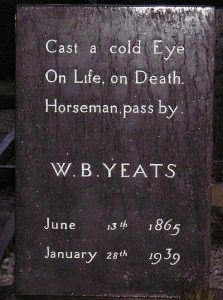
At the 1948 Sligo funeral, the town’s mayor said: “Today, we have fulfilled the express desires of W.B. Yeats, that he might rest in the shelter of Ben Bulben … Let the epitaph he wrote now be inscribed on stone. ‘Cast a cold Eye on Life, on Death. Horseman, pass by’.” Perhaps the time has come to amend those famous enigmatic lines:

“Horseman, pass by. Nothing to see here.”

Saturday, September 29, 2018

The roots of male rage


The roots of male rage, on show at the Kavanaugh hearing

Martha Nussbaum Washington Post


'This is hell': Sen. Graham calls Kavanaugh allegations 'despicable'


A wave is sweeping across our nation: a wave of fear-driven male rage. We see it not only in the hysterical outbursts from Republicans during the Senate Judiciary Committee hearing on Supreme Court nominee Brett M. Kavanaugh (Kavanaughhimself, suddenly shrill, as well as committee Chairman Charles E. Grassley and Sen. Lindsey O. Graham), but also more widely in the dark allegations of women “weaponizing the #MeToo movement,” as if masculinity itself were under attack. We are even told that good parents should tremble for the future of their sons when women can make claims against them. And, indeed, men are trembling. At the Kavanaugh hearings, as many remarked, Christine Blasey Ford’s acknowledged fear was matched and even surpassed by quivering in the voices and gestures of Republicans. What is going on?

American men do have genuine reasons for anxiety. The traditional jobs that many men have filled are disappearing, thanks to automation and outsourcing. The jobs that remain require, in most cases, higher education, which is increasingly difficult for non-affluent families to afford. We should indeed tremble for the future of both men and women in our country unless we address that problem, and related problems of declining health and well-being for working-class men.

But our public discussion does not stay focused on such genuine issues. Fear and anger have found ways to displace themselves onto other targets, above all women and their unprecedented outspokenness. Misogyny takes the place of serious deliberation.

Three emotions, all infused by fear, play a role in today’s misogyny. The most obvious is anger — at women making demands, speaking up, in general standing in the way of unearned male privilege. Women were once good mothers and good wives, props and supports for male ambition, the idea goes –but here they are asserting themselves in the workplace. Here they are daring to speak about their histories of sexual abuse at the hands of powerful men. It’s okay for women to charge strangers with rape, especially if the rapist is of inferior social status. But to dare to accuse the powerful is to assail a bastion of privilege to which men still cling.

Coupled with anger is envy. All over the world, women are seeing unprecedented success in higher education, holding a majority of university seats. In our nation many universities quietly practice affirmative action for males with inferior scores, to achieve a “gender balance” that is sometimes dictated by commitment to male sports teams, given Title IX’s mandate of proportional funding.

But men still feel that women are taking “their” places in college classes, in professional schools. A few years ago, top law schools endured an ugly envy wave, when a site that purported to give advice on law school admissions quickly became a porn site in which named female law students were woven into fictional and grossly false pornographic narratives by anonymous males, suggesting their utter unsuitability for the practice of law (despite their fine scores and grades).

Envy, propelled by fear, can be even more toxic than anger, because it involves the thought that other people enjoy the good things of life which the envier can’t hope to attain through hard work and emulation. Envy is the emotion of Aaron Burr in Lin-Manuel Miranda’s “Hamilton” (and in history), who longs despairingly to be “in the room where it happens.” Cheated of their automatic gender passport to being “in the room,” many men have become toxic enviers.

And then, beneath the hysteria, lurks a more primitive emotion: disgust at women’s animal bodies. Human beings are probably hard-wired to find signs of their mortality and animality disgusting, and to shrink from contamination by bodily fluids and blood. But in every culture something worse kicks in: the projection of these feared and loathed characteristics onto a vulnerable group or groups from whom the dominant group wishes to distance itself. In the United States, we observe this dynamic in racism, in homophobia and even in revulsion toward the bodies of people who are aging. But in every culture male disgust targets women, as emblems of bodily nature, symbolic animals by contrast to males, almost angels with pure minds.

Disgust for women’s bodily fluids is fully compatible with sexual desire. Indeed, it often singles out women seen as promiscuous, the repositories of many men’s fluids. As with the shunning of sex workers until the present day, as with the apparent defamation of Renate Dolphin in Kavanaugh’s infamous yearbook, men often crow with pride over intercourse with a woman imagined as sluttish and at the same time defame and marginalize her. As the great philosopher Adam Smith observed about post-coital disgust, “When we have dined, we order the covers to be removed.” Disgust for the female body is always tinged with anxiety, since the body symbolizes mortality. Disgust is often more deeply buried than envy and anger, but it compounds and intensifies the other negative emotions. Our president seems to be especially gripped by disgust: for women’s menstrual fluids, their bathroom breaks, the blood imagined streaming from their surgical incisions, even their flesh, if they are more than stick-thin.


How can women combat this onslaught of fear-driven rage? Ford gave an example: with courage, dignity and truth. I believe that if we have courage (and I myself did not have courage until 2015 to name the man who assaulted me in 1968), we will ultimately prevail and reshape our society.


Martha Nussbaum is a professor of law and philosophy at the University of Chicago and author of “The Monarchy of Fear: A Philosopher Looks at Our Political Crisis.” 

Rosewood