Thursday, May 01, 2014

Vision of the future or criminal eyesore: what should Rio do with its favelas?

Simon Jenkins London Guardian Feature
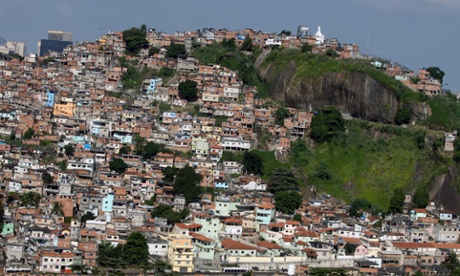
The Morro da Providencia favela rises above Rio de Janeiro's Copacabana and Ipanema beaches.Despite the looming World Cup and Olympics, constitutional reform and powerful drug lords have kept redevelopment of Rio’s squatter settlements at bay – but the price is poverty and anarchy 
 
The Morro da Providencia favela rises above Rio de Janeiro's Copacabana and Ipanema beaches. Photograph: Vanderlei Almeida/AFP/Getty Images
Violent protests broke out in a favela near Copacabana this month after a resident was killed in clashes with the army.
Violent protests broke out in a favela near Copacabana this month after a resident was killed in clashes with the army. Photograph: Christophe Simon/AFP/Getty
The granite hump of Providencia gazes down like a stern guardian on the old port of Rio de Janeiro. It offers probably the finest viewpoint over any city I know. Rio’s great bay stretches inland to distant mountains. Below lies what was once the world’s third largest port, now mostly silent. Along the coast a parade of beach resorts march to the foot of Sugar Loaf Mountain, with Copacabana and Ipamena hiding beyond. Over them all towers a range of steep rain-forested hills, crowned by the art deco beacon of Christ the Redeemer. The sight is breath-taking.
I was admiring this view from the top of the hill when I felt a hand tugging at my belt. In this city of muggers, and eager to avoid a scene, I moved quickly along the handrail, only to be alarmed when the hand came and resumed its grasp. I then noticed it belonged to a blind boy with severe disabilities. I had been blocking his only route home. It was a wretched scene amid that firmament of wonder.
In most cities, Providencia would be a Montmartre or Nob Hill, a luxury retreat above the city smoke. Yet it is Rio’s oldest favela, settled in 1897 by a group of returning war veterans. Its cheap houses remain to this day, mostly unserviced and stinking of sewage, inaccessible except by precipitous steps.
At the last count there were roughly 600 such “informal” communities, accommodating a quarter of the city's 6 million inhabitants. Over the past half century Rio’s centre of gravity has, as with many cities, drifted west from its original home. It now sprawls for over 20 miles of beaches and promontories, dramatically interspersed with mountains. Clinging to their slopes are squatter settlements, often lying immediately adjacent to rich districts “on the asphalt” below.
All developing cities – and most developed ones – have their slums. But Rio’s are remarkable in their ubiquity and in their survival in the same locations. While those on the flat can be reached by road, most are stacked on hillsides, hard to reach on wheels, flooded in storms and lacking sewerage and other public services. Until recently the favelas – named after scrub plants that once occupied them – were no-go areas for the police or government officials, and remained in thrall to feuding drugs gangs. They testify to the futility of criminalising the supply of what is a standard consumer product. The favelas are Blade Runner meets Italian hill town.
With the World Cup and Olympics looming, these places are testing Brazil’s civic conscience. Most cities would by now have contrived to clear such settlements, rehousing their inhabitants with varying degrees of compulsion elsewhere. The process can be seen from Mexico City to Lagos, from Johannesburg to Bangalore, or in London or Paris a century ago. Older areas are gentrified and this in turn draws tax revenue, private investment and political clout to deliver new urban infrastructure. Even in Rio this is happening to such historic central areas as Lapa and Santa Teresa, where old streets are starting to draw restaurants, shops and entertainment back to depressed quarters.
In Rio’s favelas, however, any such process has largely stalled. Their control by the drug lords kept all forms of government, including redevelopment, at bay, often at the point of a gun. A 1988 constitutional reform gave residents a degree of security of tenure, usually after five years of occupation, and title deeds are now reckoned to cover between a third and two-thirds of favela residents. Compulsory eviction supposedly requires local consultation and the availability of alternative housing near at hand.
Such security has not been totally effective, though. The Popular Committee for the World Cup and the Olympics, which has been behind recent protests against the football tournament, claims no fewer than 170,000 people are being removed from their homes for the games. But activists have held out against the sort of mass clearance experienced by British cities in the 1960s and 1970s and by Beijing before its Olympics. Rio has failed to remove the Vila Autódromo favela, which still stands defiantly by the fence of the new Olympic park.
For followers of post-modernism’s “new urbanism”, Rio is an exciting, infuriating place. As an urban form the favela is inherently robust, green and “sustainable”. It can offer high-density, low-cost living on locations penetrating the city centre and within reasonable reach of work. Its residents rely on walking and two-wheeled vehicles – taxis are ferocious motorbikes – creating close-knit, self-reliant communities in which ties of family and neighbour are strong. They delineate their own boundaries of loyalty and defensible space.
The 'pacified' favela of Cantagalo, which borders Pavão-Pavãozinho
The 'pacified' favela of Cantagalo. Photograph: Mario Tama/Getty
As a result the world flocks to study them. They have become intellectual works-in-progress to universities such as Pennsylvania, Columbia and the LSE. Pennsylvania even built its own campus “pop-up favela” for study purposes. A leading NGO champion, Theresa Williamson of Catalytic Communities, sees the favelas as the “ideal affordable housing stock”. Their buildings are mostly brick-built and sound, maximising every inch of space and fashioned to occupants’ needs. They are low-energy to a fault.
The challenge is somehow to upgrade them to meet even the minimal standards expected for modern urban living, without lurching into old-fashioned, state-sponsored clearance and renewal. It is the challenge of the “smart cities” movement. Rio’s authorities have long acknowledged the policy: Favela Bairro in the 1990s saw them as “civic assets” rather than “aberrations”. At its most basic, it secured the widespread concreting of alleys and stairways and introduced some sewerage. The theft of electricity was tolerated, through illicit wires that form a lethal canopy over back lanes.
Favela Bairro was assessed by the RioOnWatch website as having upgraded 168, or roughly a quarter, of the larger favelas by 2010. That year it was superseded by the Olympic “legacy” programme of Morar Carioca. Launched by the flamboyant mayor, Eduardo Paes, this allotted $4.5bn (£2.7bn) to achieve the complete “urbanisation” of the favelas by 2020. The city would be improved from the ground up and through “the participation of organised society … through assemblies and meetings in the communities”. In future, the favela would be seen not as Rio’s problem but “the solution … the visionary answer to how the world is going to deal with the third of humanity who will live in informal settlements by 2050”.
Morar Carioca was undeniably an imaginative exercise in sensitive urban renewal. Prepared with the Institute of Brazilian Architects , it would retrofit the city’s entire stock of low-cost housing, and do so free of the cost, misery and social disruption of traditional urban renewal. Houses would be left to their owners. The state would renew the public space round them.
The spirit of Morar Carioca lives, but those involved in it have been disappointed. A visit to the architects’ institute is a gloomy experience, as its president, Sergio Magalhaes, shuffles maps and plans from which one project after another has been removed. What had been “a special moment in mobilising the efforts, hopes and expectations of the people”, he says, had become merely an exercise in using the Olympics to direct investment to rich and expanding areas.
The Teleferico cable car system soars over the Alemão favela.
The Teleférico cable car system soars over the Complexo do Alemão favela in the north of the city. Photograph: Mario Tama/Getty Images
The promised investment has not been forthcoming, while government effort has been directed at favela “pacification”. Initiated in 2008, this rightly acknowledged that lasting improvement of favela living conditions required government control of law and order. Otherwise nothing would happen. This took the form of mass police incursions into one favela after another, driving the gang leaders out – even if they merely moved to others. The police then remained as a permanent presence. Favela police commanders would become, in effect, local mayors.
The programme has had its failures. Last week a police killing in the Pavão-Pavãozhino favela near Copacabana showed how easily the police can revert to old and brutal habits. The new police station in Alemão is reminiscent of Ulster’s fortified citadels during the troubles. They are hardly a sign of hearts and minds being won and have led the geographer and local blogger, Chris Gaffney, to describe it as having merely “replaced one arbitrary and militarised system of justice with another”. But killings in pacified favelas, by both police and gangs, have halved over the past five years. If pacification is not an end in itself it is the essential beginning of a process, the rule of some sort of law on which regeneration can proceed.
The trouble, as always, is the lack of resources for that regeneration. Brazil, like most modern political economies, is in thrall to mega-events. Glory lies in the grand gesture, the big scheme, the glamour project. Rio’s current pride and joy is the redevelopment of its disused port area, the Porto Maravilha project. An overhead motorway is being buried underground and a promenade laid out between the downtown and the water. Trump towers and a luxury hotel are to rise beside it. Historic 19th-century streets are being restored and an old slave dock uncovered. A curiously titled “museum of the future” designed by Santiago Calatrava is emerging on an old quay.
This is easy renewal, of a virtually empty zone of the old city. Nor has there been much attempt to repopulate it with socially mixed housing. An effort to clear a third of the adjacent favela of Providencia was balked by furious protests. A local hero, the artist Maurício Hora, campaigned against eviction by photographing threatened residents and projecting their faces on to their outside walls.
Providencia was eventually awarded not improved utilities but one of the more bizarre gestures of urban renewal I have seen. A heavily over-engineered $35m cable car runs just half way up its slope and then appears to have been abandoned. A similar contraption in London’s Docklands runs at barely 10% of capacity. Such investments are beloved of mayors, sponsors and contractors, but seldom of residents.
Brazilian artist Maurício Hora documented daily life in the Providencia favela.
Brazilian artist Maurício Hora has documented daily life in the Providencia favela. Photograph: Antonio Scorza/AFP/Getty Images
A longer cable car, meanwhile, carries a trickle of passengers over the roofs of the sprawling favela of Complexo do Alemão in north Rio. Its otherworldly structure, constantly moving cars and white-gloved attendants would seem more appropriate to a ski-lift in Gstaadt. It stops near few houses and is unavailable for heavy goods. A ground-level funicular would have made more sense.
Attempts to upgrade low-lying favelas are eerily reminiscent of similar British projects of the 1960s and 70s. I walked through what is left of Manguinhos with Leona Deckelbaum, a local housing official turned activist. It was old-fashioned federal slum redevelopment: regimented tenements gave on to desolate open spaces, with allotments and kiosks in which local people were expected to find work. While a library has been opened, most of the area was smashed and deserted, the kiosks unused.
Next door, across a no man's land of rubble, lay the remains of the surviving favela: a warren of lanes, alleys, workshops, bars, undrained and filthy. The place was regularly flooded by a polluted canal, but it was also a live community. “If only the money would have been spent just fitting drains and sewerage into the old favela,” Deckelbaum said. “But then, sewers do not look good at world urbanisation conferences – not like cable cars.”
The same lesson is evident on the outskirts of the city at Cidade de Deus. This was a state resettlement estate laid out in the 1960s and notorious as setting for the movie, City of God. It was built with only the most rudimentary infrastructure and left to run itself, which soon brought it under the aegis of drug gangs. With no government or planning and few public services, the area’s population grew to 70,000. Floors were added, yards were filled in, lanes disappeared. The original layout was swiftly obliterated. Cidade de Deus has recently been “pacified”. It yet could offer a better template of self-improved housing than a cluster of frigid municipal towers.
Yet that prospect for Rio has its own bugbears. After pacification, favelas adjacent to the coast such as Vidigal and Rocinha have seen rents and house prices surge, inviting complaints of gentrification. “Favela chic” has entered the language. TripAdvisor exults over “authentic eco-friendly favela” tours. Rocinha has coffee and sushi bars. A guest-house hotel on the summit of Vidigal has a view to rival any on the Côte d’Azur, even if it is desperate to reach. Hip restaurants and alternative bed-and-breakfasts are appearing on the back of discreet coach tours.
A boy rides a bike with no tires in the Complexo da Mare favela, which is being occupied by federal troops ahead of the World Cup.
A boy rides a bike with no tires in the Complexo da Mare favela, which is being occupied by federal troops ahead of the World Cup. Photograph: Mario Tama/Getty
This presents Rio with the classic urban paradox. The superb location of many favelas gives them immense imputed value from gentrification and tourism, value that in most cities would have long drawn to them new residents, employers and investors. They in turn would have generated resources for better services.
Yet favelas are proud places whose residents enjoy a measure of security of tenure and a growing civic confidence. “We want to be happy and walk freely in the favela where we were born,” states a protest banner in Manguinhos. Another at Vila Autódromo boasts “a peaceful and orderly neighbourhood since 1967”. As these places are upgraded and made secure, there is an inevitable impact on their desirability and price – and on the desire of some residents to realise such assets as they have and move elsewhere.
All forms of social housing sooner or later must grapple with rights of property transfer. A federal proposal to build 2,200 social housing units in the new Porto Maravilha was challenged by Rio’s mayor, Eduardo Paes, on the grounds that their residents would just sell them. “Don’t come to me with laws telling them they cannot sell,” he told a recent conference, “because they do it … everybody sells their house.” While state-run estates, condominiums and co-operatives can impede this, the implied legal control is a far cry from a Rio favela. Besides, the essence of the favela sovereignty is local ownership.
Any visitor to Rio’s poorer districts sees a glaring conflict between the chronic need for investment and the frozen value of the land. People want services “from the ground up”, yet are sceptical of the necessary resources being generated by their own rents and taxes – even if it were to mean new residents, investment in infrastructure, jobs and civic clout. They see gentrification leading to evictions, even where the residents themselves would benefit from property sales. Their default is to see the state as responsible for retrofitting their communities.
All urban renewal is a conflict between social geography and the market for land. Since the 1980s, Rio’s favelas have “traded” a degree of security of low-cost tenure for dreadful living conditions and crime-ridden governance. The constitutional “right to occupy” a particular plot of land has been at the price of zero investment, poverty and anarchy. The freedom to stay put implies bondage, if it means being unable to up sticks and move, taking the value of one’s home with one. Paes himself recognises this, and is reluctant to control the housing market and become “the Fidel Castro of the favelas”.
Life in the Cantagalo favela, near Copacabana.
Life in the Cantagalo favela. Photograph: Tasso Marcelo/AFP/Getty Images
The favelas are thus a test bed of every tenet of modern urban renewal. They are defended by new urbanists as the social housing stock of the future. But if they remain static communities, they will never see the investment they sorely need. Their aspiring and enterprising young will leave in search of more salubrious living quarters, while their parents stay, as in urban ghettos the world over, prisoners of an archaic poverty.
Rio’s favelas may entrance academics as sustainable informal housing, but academic fashion builds no drains, pipes, schools or clinics. Letting the property market rip is clearly not acceptable, and can be as traumatic to a community as were the mass slum clearances of the 20th century. But there has to be a compromise between gentrification and stasis. Somewhere in a freer residential property market lie the resources to update these places.
Favelas are exciting as a remarkable surviving pattern of urban living. A vision, sensitive and workable, is in place for their renewal. But Rio is still searching for a way to implement it.
Simon Jenkins: the World Cup and Olympics threaten to overwhelm Rio

Monday, April 28, 2014

Andrew Sullivan reflects on debate over Bart Erham's "When Jesus Became God"
From "The Dish" Andrew Sullivan
I’m sorry for not jumping into the debate more this weekend, but the pollen bukakke in DC right now has reduced my lung capacity a bit, and thinking about the resurrection is even more difficult while hooked up to a nebulizer with albuterol than is usually the case. Mercifully, many of my responses to this batch of criticism were pre-empted, rather eloquently, by this batch of counter-criticism.
A few thoughts on this question: given the many contemporaneous accounts of other religious figures rising from the dead (indeed several in
the Bible itself), and given that all Christians are supposed to rise bodily from the dead as well, why is Jesus so special? Why is he "consubstantial with the Father" in ways other resurrected beings are not?
The obvious answer to this is that the early Christians obviously believed that he was uniquely divine in some form. Ehrman makes a good case that Jesus was viewed as special by his disciples in his lifetime because they deemed him to be the Jewish Messiah who would reign supreme at the end of the world. The specialness of his being the Jewish Messiah was then combined with the staggering revelation that he had risen from the dead. It was that combination – a resurrected Messiah – that upped the ante, setting the seeds for the gradual evolution of the doctrine of the Incarnation and the Trinity. The story of Apollonius, otherwise very close to the story of Jesus, lacked the Messiah prophesy. And it also lacked the retroactive examination of the Hebrew Bible for various prophesies to be fulfilled in Jesus.
Moreover, as Ehrman notes, although there were countless semi-divine characters and resurrected prophets in the early Christian era, even though the human-divine admixture included angels and strange gods and the off-spring of unnatural sex between gods and humans, only
two people were ever designated the "Son Of God." One was the Roman Emperor, Caesar Augustus, and the other was Jesus, a rural apocalyptic preacher from Galilee. That is some elevated company to keep and it begs the question: why Jesus and no one else? What was so special about him?
What’s frustratingly lacking in Ehrman’s book – and it’s not its subject so it’s not Ehrman’s fault – are the teachings of Jesus and the way he lived. I don’t think you can understanding the full impact of the resurrection outside the disciples’ experience of the living Jesus, with his teachings and his healings and his miracles. For me, these remarkable stories are the missing tissue here. It is one thing for a prophet to be put to a gruesome death; it is another thing when that prophet lived and taught in such a way that he seemed to revolutionize human consciousness and then was put to death.
Jesus inverted so much of the world’s familiar lessons: don’t protect yourself in a dangerous world, make yourself vulnerable; don’t seek revenge on those who have wronged you, give them another chance to wrong you; don’t just love your friends, but love your enemies; don’t live abstemiously, give everything you have away to the poor; don’t worry about tomorrow, today will be taken care of; by all means obey the rules but never if they violate the deeper rule of love. Above all: love one another. These stories and sayings and teachings carry huge impact
today, even though we have lived with them for centuries. But I try to imagine myself as one of the disciples, busily fishing in the Sea of Galilee, and not only being astounded by these ideas, but dropping my life and abandoning my family altogether and following him because of the power of his ideas and example.
Then, in a sudden development, this radically non-violent individual is seized under false pretenses and brutally tortured to death. And again, even here, it is not so much his death that resonates as the manner of his death. He refused to defend himself; he embraced the ridicule; he forgave the men driving nails into his wrists; he reached out in love to one of the poor souls hanging next to him; and he despaired. This happens after most of his loved ones either denied ever knowing him or fled. Only the women who loved him and the disciple Jesus loved stayed behind.
Now put yourself in the place of those bewildered, terrified, disloyal former followers.
In this miasma of fear, guilt, grief and disorientation, they suddenly see Jesus alive and walking around in various visions and mysterious manifestations. There you have the whiplash of the resurrection, and the obvious desire of the disciples to believe that all of it must mean something more profound than merely that Jesus was a man of God who was unjustly put to death. He was more than that to them – and the resurrection made that indelible. And I find it perfectly reasonable to see why the disciples began to tell and re-tell the stories of Jesus life as a way to keep him alive in their hearts and minds and to buttress and deepen the meaning of this revelation. I find it perfectly human to re-enact his last supper with them as a way to keep his memory and his presence in their lives.

In other words, Occam’s razor needs to take into account the life-changing ideas and the soul-changing way of life Jesus of Nazareth gave the world. When I say a deeper perfection lies behind the fallible game of telephone that the Gospels are, I mean simply this. The words that Jefferson excavated, the stories that Tolstoy marveled at, the way of life that Francis of Assisi embraced, all of this and so much more come from this man’s words and life. There is always something astounding when the victims of violence refuse to fight back and seek to love instead. It defuses all of our evolutionary impulses. It negates what was previously thought of as human. It instantly makes one think of something divine.
There are many ways of understanding this, and Christians, as Ehrman shows, came up with countless permutations on the notion of God-Made-Flesh within the Trinity. None of it makes any worldly sense, the Trinity especially. It makes sense only as paradox and mystery, not as literal truth. And so I do not have a firm belief in the bodily resurrection of Jesus, because the Gospels don’t either. He is a vision, an angel, a man who walks through doors only to reveal himself in the flesh … and then he withdraws again from view. There is no single, literal account in the Jesus stories of his resurrection, which is one reason I prefer to leave its precise contours a little opaque. Ehrman suggests the conviction that Jesus had risen from the dead might be an instance of a very common form of vision of recently dead loved ones – which was not unique to the disciples but witnessed countless times across the globe then and now. And I sure keep that option open.
But because it is a mystery, I do not discount the possibility of a literal resurrection either. What matters to me is the life-changing message of Jesus, potent and rendered in unforgettable metaphor and parable, lived by him to the astonishment of all who encountered him, and speaking of a form of justice, of life and of love that we rightly associate with some power beyond us – because so much in our evolutionary make-up screams against it and yet somewhere within us we recognize it is the only transcendence we are capable of. In that sense, Jesus was the intersection of timeless truth with time. And nothing could be more miraculous in the long and brutal history of humankind than that.


Thursday, April 24, 2014

Philanthropist Admits Stealing More Than $1 Million From Charity

By JAMES C. McKINLEY Jr. NY TIMES


For most of his long and very public life as a philanthropist, William E. Rapfogel has been surrounded by powerful friends and politicians, chief among them Sheldon Silver, the New York State Assembly speaker.

But as he sat in State Supreme Court in Manhattan on Wednesday, about to plead guilty to several criminal charges, Mr. Rapfogel was all alone.

Grim-faced in a dark suit and black skullcap, Mr. Rapfogel quietly read passages from a well-thumbed copy of the Torah while his lawyers, Alan Vinegrad and Paul L. Shechtman, went over terms of a plea agreement.

A few minutes later, Mr. Rapfogel, 59, stood before Justice Larry Stephen and admitted stealing more than $1 million from the Metropolitan Council on Jewish Poverty, the influential social service organization he had led for more than two decades.

Mr. Rapfogel said he had overseen a scheme for 20 years, colluding with the owner of an insurance company and two other executives at the charity to overcharge the council for insurance policies and skim off cash. The state attorney general, Eric T. Schneiderman, said they had looted more than $9 million from the nonprofit

Mr. Rapfogel with his other lawyer Alan Vinegrad, left. Credit Brian Harkin for The New York Times

The plea marked a stunning downfall for a man once considered one of the New York City’s most respected philanthropists, whose work and close ties to Mr. Silver, a Manhattan Democrat, gave him influence and prominence in political circles.

In the end, no one stood with Mr. Rapfogel as he pleaded guilty to grand larceny, money laundering, tax fraud and filing false documents to the city campaign finance board. His wife, Judy, the longtime chief of staff to Mr. Silver, was not there; neither was Mr. Silver, who over the years has allocated millions of public dollars to Met Council.

Mr. Rapfogel will be sentenced to 31/3 to 10 years in prison and must pay $3 million in restitution to the charity; to date, he has repaid $1.8 million. If he fails to pay the full restitution by his sentencing date, July 16, he will be sentenced to four to 12 years in prison, Gary T. Fishman, an assistant attorney general, said in court.

Mr. Rapfogel, the former chief executive of the council, did not apologize publicly, and gave only a short explanation of what he had done, saying he had "knowingly helped steal more than $1 million from the Metropolitan Council on Jewish Poverty as part of a scheme in which insurance premiums were overstated."

According to a plea agreement filed in court and an earlier criminal complaint, Mr. Rapfogel gave about $350,000 of the stolen funds to one of his three sons to buy a home. The agreement states the attorney general will not seek to recover that money from the son, who has not been identified, though Mr. Rapfogel has promised to pay it back.

Neither Mr. Silver nor Ms. Rapfogel has been linked to the financial irregularities at the Met Council, and they have denied any knowledge of Mr. Rapfogel’s activities. The assembly speaker issued a terse statement about Mr. Rapfogel’s plea, saying simply: "I am deeply saddened by this entire episode." Ms. Rapfogel declined to comment through a spokesman, Stu Loeser.

An hour earlier, another defendant charged in the scheme, David Cohen, who was Mr. Rapfogel’s predecessor at the council, pleaded guilty to grand larceny and conspiracy before Justice Michael J. Obus. Mr. Cohen, 70, promised to pay back $650,000 that he said he had stolen from the charity starting in 1992, and he has already returned $500,000, prosecutors said. He will serve one year in prison under an agreement reached between his lawyer, Alan M. Abramson, and the attorney general’s office.

Mr. Cohen, in his statement to the court, said he set up the scheme in 1992, conspiring with Herb Friedman, who was the chief financial officer, and Joseph Ross, the owner of Met Council’s insurance broker, Century Coverage Corporation.
Mr. Ross, 58, admitted to his role in the fraud in December, pleading guilty to grand larceny, money laundering and tax fraud. Mr. Friedman was also arrested and will face conspiracy charges.


At heart it was a simple scheme, Mr. Cohen said. The insurance company submitted inflated invoices to the council, which in turn paid the bills. Mr. Ross would then send the difference between the true cost of the insurance and the inflated amount to Mr. Cohen in cash. Mr. Cohen said in court that in the early years, the stolen money totaled about $20,000 to $30,000 a year.

Six months after the scheme started, Mr. Rapfogel took over as the charity’s chief executive, and soon began getting a share of the money, Mr. Cohen said. In 1995, Mr. Rapfogel took over running the scheme; by 2013, Mr. Rapfogel was receiving $30,000 a month, Mr. Cohen said.

Mr. Cohen, who is to be sentenced on July 9, said he and Mr. Rapfogel also funneled some of the illicit money to candidates running for office, asking Mr. Ross to make contributions not only in his name but also in the names of his employees and partners in the company. "These campaign contributions were made to politicians Willie and I thought would help Met Council — mainly, candidates for city elected offices," Mr. Cohen told the judge.

A criminal complaint filed against Mr. Ross said he had channeled at least $120,000 of the stolen funds to candidates for city office over the last 20 years. Met Council receives much of its funding through state and city grants and contracts, as well as from funds earmarked by individual lawmakers.
Mr. Rapfogel’s scheme began to unravel last year after officials at Met Council received an anonymous letter detailing improprieties with insurance payments, and a law firm hired to investigate found evidence that the payments had been padded. Mr. Rapfogel, who received a $400,000 salary, was fired in August.


That investigation prompted the attorney general and the state comptroller to start a criminal inquiry. Facing lengthy prison sentences, Mr. Ross, Mr. Friedman and Mr. Cohen all agreed to cooperate with investigators, according to defense lawyers.

William K. Rashbaum contributed reporting.

Sunday, April 20, 2014

|In Cold War Echo, Obama Strategy Writes Off Putin

 WASHINGTON — Even as the crisis in Ukraine continues to defy easy resolution, President Obama and his national security team are looking beyond the immediate conflict to forge a new long-term approach to Russia that applies an updated version of the Cold War strategy of containment.
Just as the United States resolved in the aftermath of World War II to counter the Soviet Union and its global ambitions, Mr. Obama is focused on isolating President Vladimir V. Putin’s Russia by cutting off its economic and political ties to the outside world, limiting its expansionist ambitions in its own neighborhood and effectively making it a pariah state.

Mr. Obama has concluded that even if there is a resolution to the current standoff over Crimea and eastern Ukraine, he will never have a constructive relationship with Mr. Putin, aides said. As a result, Mr. Obama will spend his final two and a half years in office trying to minimize the disruption Mr. Putin can cause, preserve whatever marginal cooperation can be saved and otherwise ignore the master of the Kremlin in favor of other foreign policy areas where progress remains possible
 
“That is the strategy we ought to be pursuing,” said Ivo H. Daalder, formerly Mr. Obama’s ambassador to NATO and now president of the Chicago Council on Global Affairs. “If you just stand there, be confident and raise the cost gradually and increasingly to Russia, that doesn’t solve your Crimea problem and it probably doesn’t solve your eastern Ukraine problem. But it may solve your Russia problem.”
The manifestation of this thinking can be seen in Mr. Obama’s pending choice for the next ambassador to Moscow. While not officially final, the White House is preparing to nominate John F. Tefft, a career diplomat who previously served as ambassador to Ukraine, Georgia and Lithuania.
When the search began months ago, administration officials were leery of sending Mr. Tefft because of concern that his experience in former Soviet republics that have flouted Moscow’s influence would irritate Russia. Now, officials said, there is no reluctance to offend the Kremlin.
In effect, Mr. Obama is retrofitting for a new age the approach to Moscow that was first set out by the diplomat George F. Kennan in 1947 and that dominated American strategy through the fall of the Soviet Union. The administration’s priority is to hold together an international consensus against Russia, including even China, its longtime supporter on the United Nations Security Council.
While Mr. Obama’s long-term approach takes shape, though, a quiet debate has roiled his administration over how far to go in the short term. So far, economic advisers and White House aides urging a measured approach have won out, prevailing upon a cautious president to take one incremental step at a time out of fear of getting too far ahead of skittish Europeans and risking damage to still-fragile economies on both sides of the Atlantic.
The White House has prepared another list of Russian figures and institutions to sanction in the next few days if Moscow does not follow through on an agreement sealed in Geneva on Thursday to defuse the crisis, as Obama aides anticipate. But the president will not extend the punitive measures to whole sectors of the Russian economy, as some administration officials prefer, absent a dramatic escalation.
 
The more hawkish faction in the State and Defense Departments has grown increasingly frustrated, privately worrying that Mr. Obama has come across as weak and unintentionally sent the message that he has written off Crimea after Russia’s annexation. They have pressed for faster and more expansive sanctions, only to wait while memos sit in the White House without action. Mr. Obama has not even imposed sanctions on a list of Russian human rights violators waiting for approval since last winter.
“They’re playing us,” Senator Bob Corker of Tennessee, the ranking Republican on the Foreign Relations Committee, said of the Russians, expressing a sentiment that is also shared by some inside the Obama administration. “We continue to watch what they’re doing and try to respond to that,” he said on CNN on Friday. “But it seems that in doing so, we create a policy that’s always a day late and a dollar short.”
The prevailing view in the West Wing, though, is that while Mr. Putin seems for now to be enjoying the glow of success, he will eventually discover how much economic harm he has brought on his country. Mr. Obama’s aides noted the fall of the Russian stock market and the ruble, capital flight from the country and the increasing reluctance of foreign investors to expand dealings in Russia.
 They argued that while American and European sanctions have not yet targeted wide parts of the Russian economy, they have sent a message to international businesses, and that just the threat of broader measures has produced a chilling effect. If the Russian economy suffers over the long term, senior American officials said, then Mr. Putin’s implicit compact with the Russian public promising growth for political control could be sundered.

That may not happen quickly, however, and in the meantime, Mr. Obama seems intent on not letting Russia dominate his presidency. While Mr. Obama spends a lot of time on the Ukraine crisis, it does not seem to absorb him. Speaking privately with visitors, he is more likely to bring up topics like health care and the Republicans in Congress than Mr. Putin. Ukraine, he tells people, is not a major concern for most Americans, who are focused on the economy and other issues closer to home.
Since returning from a trip to Europe last month, Mr. Obama has concentrated his public schedule around issues like job training and the minimum wage. Even after his diplomatic team reached the Geneva agreement to de-escalate the crisis last week, Mr. Obama headed to the White House briefing room not to talk about that but to hail new enrollment numbers he said validated his health care program.
Reporters asked about Ukraine anyway, as he knew they would, and he expressed skepticism about the prospects of the Geneva accord that his secretary of state, John Kerry, had just brokered. But when a reporter turned the subject back to health care, Mr. Obama happily exclaimed, “Yeah, let’s talk about that.”
That represents a remarkable turnaround from the start of Mr. Obama’s presidency, when he nursed dreams of forging a new partnership with Russia. Now the question is how much of the relationship can be saved. Mr. Obama helped Russia gain admission to the World Trade Organization; now he is working to limit its access to external financial markets.
But the two sides have not completely cut off ties. American troops and equipment are still traveling through Russian territory en route to and from Afghanistan. Astronauts from the two countries are currently in orbit together at the International Space Station, supplied by Russian rockets. A joint program decommissioning old Russian weapons systems has not been curtailed.
Nuclear inspections under the New Start arms control treaty Mr. Obama signed in his first term continue. The Air Force still relies on rockets with Russian-made engines to launch military satellites into space, although it is reviewing that. The United States has not moved to try to push Russia out of the W.T.O. And the Obama administration is still working with Russia on disarming Syria’s chemical weapons and negotiating a deal with Iran to curtail its nuclear program.
 
“You can’t isolate everything from a general worsening of the relationship and the rhetoric,” said Graham Allison, director of the Belfer Center for Science and International Affairs at Harvard University and an adviser to multiple administrations on Russia and defense policy. “But there’s still very high priority business that we have to try to do with Russia.”
Still, the relationship cannot return to normal either, even if the Ukraine situation is settled soon, specialists said. “There’s really been a sea change not only here but in much of Europe about Russia,” said Robert Nurick, a Russia expert at the Atlantic Council. “A lot of the old assumptions about what we were doing and where we were going and what was possible are gone, and will stay that way as long as Putin’s there.”
 
Mr. Nurick said discussion had already begun inside the administration about where and under what conditions the United States might engage with Russia in the future. “But I can’t imagine this administration expending a lot of political capital on this relationship except to manage it so that the other things they care about a lot more than Russia are not injured too badly,” he said.


Friday, April 18, 2014

Entwining Tales of Time, Memory and Love
The Magus of magical realism, Gabriel García Márquez — who died on Thursday at his home in Mexico City, at the age of 87 — used his fecund imagination and exuberant sleight of hand to conjure the miraculous in his fiction: plagues of insomnia and forgetfulness, a cluster of magical grapes containing the secret of death, an all-night rain of yellow blossoms, a swamp of lilies oozing blood, a Spanish galleon marooned in a Latin American jungle, cattle born bearing the brand of their owner.
Such images were not simply tokens of his endlessly inventive mind, but testaments to his all-embracing artistic vision, which recognized the extraordinary in the mundane, the familiar in the fantastic. In novels like "One Hundred Years of Solitude," "The Autumn of the Patriarch" and "Love in the Time of Cholera," Mr. García Márquez mythologized the history of an entire continent, while at the same time creating a Rabelaisian portrait of the human condition as a febrile dream in which love and suffering and redemption endlessly cycle back on themselves on a Möbius strip in time.
Transactions between the real and surreal, the ordinary and the fabulous, of course, are a signature device of the magical realism that flourished in the second half of the 20th century in places like Latin America, where the horrors and dislocations of history frequently exceeded the reach of logic, reason and conventional narrative techniques. What he called the "outsized reality" of Latin America’s history — including the period of civil strife in Colombia known as La Violencia, which claimed the lives of as many as 300,000 during the late 1940s and ’50s — demanded a means of expression beyond the rationalities of old-fashioned narrative realism.
As Mr. García Márquez’s memoir "Living to Tell the Tale" made clear, however, his fascination with the phantasmagorical was as rooted in his own childhood and family history as it was in the civil wars and political upheavals of his country. His grandfather painted the walls of his workshop white so that the young boy, nicknamed Gabo, would have an inviting surface on which to draw and fantasize; his grandmother spoke of the visions she experienced everyday — the rocking chair that rocked alone, "the scent of jasmines from the garden" that "was like an invisible ghost."
His childhood home was in the remote town of Aracataca, a Wild West sort of place, subject to dry hurricanes, killing droughts, sudden floods, plagues of locusts and "a leaf storm" of fortune hunters, drawn by the so-called banana fever fomented there by the arrival of the United Fruit Company. Aracataca would provide the seeds for the imaginary town of Macondo in "Solitude," just as Mr. García Márquez’s own sprawling family would help inspire the story of the prolific and amazing Buendía clan memorialized with such ardor in that novel. Macondo is a place where the miraculous and the monstrous are equally part of daily life, a place where the boundaries between reality and dreams are blurred. It is, at once, a state of mind, a mythologized version of Latin America and a reimagining of the author’s boyhood town through the prism of memory and nostalgia.
For that matter, the magic in Mr. García Márquez’s work always remained grounded in a carefully observed reality — a skill honed by his early years as a reporter. From that start, Mr. García Márquez slowly developed his own distinctive voice — a voice with the sinuous rhythms of Faulkner and Joyce, the metaphorical reach of Kafka, the dreamlike imagery of Borges. In later years, the fevered flights of fantasy that distinguished "Solitude" and "Patriarch" would give way to a somewhat more muted sorcery, an appreciation — demonstrated in works like "Love in the Time of Cholera" and "Of Love and Other Demons" — of the everyday, combined with a recognition that the extremes of human love and suffering could be found in the seemingly most ordinary of lives.
"Love in the Time of Cholera" was a sort of Proustian meditation on time and an anatomy of love in all its forms — giddy adolescent love, mature love, romantic love, sexual love, spiritual love, even love so virulent it resembles cholera in its capacity to inflict pain. At the same time, it was also a kind of tribute to his own parents’ courtship and marriage.
The personal gave way to the historical in some novels that dealt on an epic level with the tortuous history of Latin America. "The Autumn of the Patriarch" created a hallucinatory portrait of a tyrant who seems like a mythic composite of every dictator to strong-arm his way to power on that continent: a once-feted hero, who sells out his country to the gringos, murders his opponents, rewards himself with medals, unimaginable wealth and the modest title "General of the Universe," and who ends up completely isolated, discovered dead in his palace, pecked at by vultures.
As for "The General in His Labyrinth," it performed a kind of free-form improvisation on the life of the 19th-century revolutionary Simón Bolívar, who becomes in Mr. García Márquez’s telling a close relative of many of his fictional heroes — a spoiled dreamer, torn between martyrdom and hedonism, extravagant ambitions and crashing disillusion.
In the end, it’s not politics, but time and memory and love that stand at the heart of Mr. García Márquez’s work. How the histories of continents and nations and families often loop back on themselves; how time past shapes time present; how passion can alter the trajectory of a life — these are the melodies that thread their way persistently through his fiction, reverberating in novel after novel, story after story. In later works, like the stories in "Strange Pilgrims" and the novella "Memories of My Melancholy Whores," Mr. García Márquez wrote about older characters, falling under the shadow of mortality, but then, death had long been a focal point in his work, going back to his early novella "Leaf Storm," and on through novels like "The Autumn of the Patriarch."
Mr. García Márquez once wrote that, as a young man, he believed his bad luck with women and money was "congenital and irremediable," but he did not care, "because I believed I did not need good luck to write well," and "I did not care about glory, or money, or old age, because I was sure I was going to die very young, and in the street." He learned, in reading the works of the masters like Faulkner and Joyce, he said, that "it was not necessary to demonstrate facts," that it "was enough for the author to have written something for it to be true, with no proofs other than the power of his talent and the authority of his voice."
 
A García Márquez Sampler

One Hundred Years of Solitude

Translated by Gregory Rabassa, Harper & Row (1970)
“The men on the expedition felt overwhelmed by their most ancient memories in that paradise of dampness and silence, going back to before original sin, as their boots sank into pools of steaming oil and their machetes destroyed bloody lilies and golden salamanders. For a week, almost without speaking, they went ahead like sleepwalkers through a universe of grief, lighted only by the tenuous reflection of luminous insects, and their lungs were overwhelmed by a suffocating smell of blood.”

Love in the Time of Cholera

Translated by Edith Grossman, Alfred A. Knopf (1988)
“Contrary to what the Captain and Zenaida supposed, they no longer felt like newlyweds, and even less like belated lovers. It was if they had leapt over the arduous calvary of conjugal life and gone straight to the heart of love. They were together in silence like an old married couple wary of life, beyond the pitfalls of passion, beyond the brutal mockery of hope and the phantoms of disillusion; beyond love. For they had lived together long enough to know that love was always love, anytime and anyplace, but it was more solid the closer it came to death.”

Of Love and Other Demons

Translated by Edith Grossman, Alfred A. Knopf (1995)
“The stone shattered at the first blow of a pickax and a stream of living hair the intense color of copper spilled out of the crypt. The foreman, with the help of the laborers, attempted to uncover all the hair, and the more of it they brought out, the longer and more abundant it seemed, until at last the final strands appeared still attached to the skull of a young girl....Spread out on the floor, the splendid hair measured 22 meters, 11 centimeters.”
 

Thursday, April 17, 2014

Hillary Clinton Struggles to Define a Legacy in Progress
By MARK LANDLER and AMY CHOZICK NY TIMES

"I really see my role as secretary, and, in fact, leadership in general in a democracy, as a relay race. I mean, you run the best race you can run, you hand off the baton," Hillary Rodham Clinton says. Credit Ben Margot/Associated Press

WASHINGTON — It was a simple question to someone accustomed to much tougher ones: What was her proudest achievement as secretary of state? But for a moment, Hillary Rodham Clinton, appearing recently before a friendly audience at a women’s forum in Manhattan, seemed flustered.

Mrs. Clinton played an energetic role in virtually every foreign policy issue of President Obama’s first term, advocating generally hawkish views internally while using her celebrity to try to restore America’s global standing after the hit it took during the George W. Bush administration.

But her halting answer suggests a problem that Mrs. Clinton could confront as she recounts her record in Mr. Obama’s cabinet before a possible run for president in 2016: Much of what she labored over so conscientiously is either unfinished business or has gone awry in his second term.

From Russia’s aggression in Ukraine and the grinding civil war in Syria to the latest impasse in the Middle East peace process, the turbulent world has frustrated Mr. Obama, and is now defying Mrs. Clinton’s attempts to articulate a tangible diplomatic legacy.

Hillary Rodham Clinton is striking a delicate balance when discussing her tenure as the secretary of state. Here in 2010, Mrs. Clinton visited Sharm el Sheik, Egypt, for Mideast talks. Prime Minister Benjamin Netanyahu of Israel is at left, and Mahmoud Abbas, president of the Palestinian Authority, is second from right.

"I really see my role as secretary, and, in fact, leadership in general in a democracy, as a relay race," Mrs. Clinton finally said at the Women in the World meeting, promising to offer specific examples in a memoir she is writing that is scheduled to be released in June. "I mean, you run the best race you can run, you hand off the baton."

The relay metaphor has become a recurring theme for Mrs. Clinton during this year of speculation about her future. She did her part, it suggests, but the outcome was out of her hands. And so Mrs. Clinton is striking a delicate balance when discussing a job that would be a critical credential in a presidential race.

On the one hand, she wants credit for the parts of Mr. Obama’s foreign policy that have worked, like the pressure campaign against Iran over its nuclear program, which she helped orchestrate and which has pulled Iran to the bargaining table. On the other, she is subtly distancing herself from the things that have not worked out, like Mr. Obama’s "reset" of relations with Russia. She recently likened President Vladimir V. Putin’s annexation of Crimea to actions by Hitler in the 1930s, and posted on Twitter a photograph of herself with members of Pussy Riot, the protest group that is Mr. Putin’s nemesis.

Mrs. Clinton’s Republican opponents, losing no time in trying to define her, note that she gave Russia’s foreign minister the infamous mistranslated red plastic button to reset relations. It said "overcharge," not "reset." They have been tireless in raising questions about the deadly attack on the American diplomatic mission in Benghazi, Libya.

While Republicans are likely to make her part of a broad critique of the Obama administration’s approach to national security, Mrs. Clinton’s hawkish views could also be a problem in ensuring the support of liberals in her own party, who are weary of foreign entanglements.

In one sense, though, the cascade of foreign crises that now bedevil Mr. Obama could play to Mrs. Clinton’s advantage. By presenting herself in her book and in any possible campaign as the toughest voice in the room during the great debates over war and peace, she could set herself apart from a president who critics charge has forsworn America’s leadership role in the world.

Mrs. Clinton has scrupulously avoided publicly criticizing Mr. Obama; White House aides said he still called her for advice. And much of the administration’s foreign policy still bears her imprint, like the Iran sanctions and a more confrontational stance toward China, which she pioneered and Mr. Obama has embraced.

But in recent interviews, two dozen current and former administration officials, foreign diplomats, friends and outside analysts described Mrs. Clinton as almost always the advocate of the most aggressive actions considered by Mr. Obama’s national security team — and not just in well-documented cases, like the debate over how many additional American troops to send to Afghanistan or the NATO airstrikes in Libya.

Mrs. Clinton’s advocates — a swelling number in Washington, where people are already looking to the next administration — are quick to cite other cases in which she took more hawkish positions than the White House: arguing for funneling weapons to Syrian rebels and for leaving more troops behind in postwar Iraq, and criticizing the results of a 2011 parliamentary election in Russia.

The criticism of the Russian election led Mr. Putin to accuse her of fomenting unrest, and left some senior Obama aides unhappy. "Some at the White House thought she overstepped," said Michael A. McFaul, a former ambassador to Russia, who supported her view.

At the same time, Mrs. Clinton’s instincts were curbed by her innate caution, her determination to show loyalty to a rival-turned-boss and her growing pains in the job. Still, dissecting her record yields tantalizing clues about what kind of foreign policy she might pursue as president. "Hillary unbound," people who worked with her say, would be instinctively less reluctant than Mr. Obama to commit the military to foreign conflicts.

"It’s not that she’s quick to use force, but her basic instincts are governed more by the uses of hard power," said Dennis B. Ross, a former White House aide who played a behind-the-scenes role in opening secret direct talks with Iran about its nuclear program.

Leon E. Panetta, who forged close ties to Mrs. Clinton as defense secretary and C.I.A. director, said she was a stalwart supporter of the C.I.A.’s activities in Pakistan — read, drone strikes — and an influential voice in advising Mr. Obama to order the raid that killed Osama bin Laden.

"The president has made some tough decisions," Mr. Panetta said. "But it’s been a mixed record, and the concern is, the president defining what America’s role in the world is in the 21st century hasn’t happened."

"Hopefully, he’ll do it," Mr. Panetta said, "and certainly, she would."


The Mideast Peace Process
Mrs. Clinton’s hawkish inclinations were well established in her bitter 2008 Democratic primary campaign against Mr. Obama, when she famously criticized as naïve his willingness to talk to America’s adversaries without preconditions. But when he persuaded her to join his "team of rivals," she submerged her views and worked hard to establish her loyalty — all of which has added to her problems in promoting her record.


A case in point is the Middle East peace process, in which secretaries of state from Henry A. Kissinger to John Kerry have tried to make their mark. "There’s core-course curriculum, and then there’s extra credit," said Denis R. McDonough, the White House chief of staff. "This is always seen as a core requirement for a secretary of state."

Mrs. Clinton’s marching orders from the White House were to demand that Israel cease the building of Jewish settlements in the West Bank as a way to lure the Palestinians into talks, and she did so with a fervor that surprised Mr. Obama’s advisers. But they had conceived the strategy, and Mrs. Clinton privately had qualms with it, which proved well founded.

"We did not make it sufficiently clear that this was not a precondition but part of an effort to create an overall atmosphere in which negotiations could succeed," said George J. Mitchell, the former Middle East envoy who left in 2011 after failing to break the logjam.

Mr. Kerry has tried a different approach to peacemaking, with little to show for it so far. But he seems determined to keep trying, while some veterans of Middle East diplomacy say Mrs. Clinton gave up too easily. In a recent interview with Time magazine, former President Jimmy Carter said that "she took very little action to bring about peace."

Today, when Mrs. Clinton’s aides talk about the Middle East, they barely mention the Israeli-Palestinian talks, preferring to discuss the cease-fire she brokered in November 2012 between Israel and Hamas in Gaza, where she twisted arms to avoid escalating violence.


Building Pressure on Iran
Mrs. Clinton was more successful in dealing with Iran. As with the Middle East, she was skeptical that Mr. Obama’s initial strategy — reaching out to Iran’s leaders — would work. So when he shifted to sanctions, she was eager to build pressure on what she called a "military dictatorship."

It was a tough job against long odds, said Tom Donilon, the former national security adviser, because it meant pressing allies in Europe and Asia, huge trading partners of Iran, to agree to steps "that had a real cost."

Mrs. Clinton delivered her stern message with a smile. In June 2010, the day before the United Nations voted on strict new sanctions against Iran, Mrs. Clinton invited China’s ambassador to Washington, Zhang Yesui, to a hotel bar in Lima, Peru, where both were at a conference.

Drinking pisco sours, the potent local cocktail, Mrs. Clinton and Mr. Zhang went over an annex to the Security Council resolution line by line as she tried to clinch Beijing’s agreement to withdraw investments in Iran by Chinese banks and state-owned enterprises.

The sanctions, Mrs. Clinton likes to remind audiences, crippled Iran’s oil exports and currency, setting the stage for the election of Hassan Rouhani, a relative moderate, as president and for Iran’s renewed interest in diplomacy.

Mr. Obama had first proposed direct talks in a letter to Iran’s supreme leader, Ayatollah Ali Khamenei, in 2009. Mrs. Clinton authorized Mr. Ross, then her special adviser, to explore a back channel to the Iranians through the Arab sultanate of Oman.

In January 2011, Mrs. Clinton stopped in Oman on a tour of the Persian Gulf that was notable because she gave a speech, on the eve of the Arab Spring, warning leaders that they risked "sinking in the sand" if they did not reform their societies. Less noticed was her meeting with the sultan, in which he offered to facilitate a meeting with the Iranians.

After some exploratory meetings with a delegation from Tehran, Mrs. Clinton sent two of her top lieutenants, William J. Burns and Jake Sullivan, to Oman for more intensive negotiations. That opened the door to the nuclear talks now underway in Vienna. But what her colleagues remember most is her steadfast conviction that Iran would deal only under duress.

"She was skeptical that it would produce anything, or at least anything quickly, and in a way she was right because it took several years to get to that point," said Mr. Burns, a deputy secretary of state.

Good quesition, Tim,Good question...because if you know history, then you´ll know men denied women freedom of action and education for...

Why does this woman still command a headline. This woman is a liar and an ineffective stateswoman who needs to find a rock to crawl under...

From being the original "birther" to "what difference does it make!", Hillary has a lot of negatives, despite the daily fawning on MSNBC....

With China, too, Mrs. Clinton set the stage for a more confrontational approach, though that was not the policy she followed at the outset. When she made her first trip as secretary of state to Beijing, she stumbled by suggesting that the United States would not offer lectures on human rights as much as it had in the past.

By 2010, however, she sounded more like the woman who had cut her teeth on the global stage in 1995 with a defiant speech on women’s rights at a United Nations conference in Beijing. Attending a summit meeting in Vietnam, she thrust the United States into a tangled dispute between China and its neighbors over the South China Sea.

The Chinese government was enraged by her meddling, but her actions set a new context for the relationship. By insisting that China adhere to international norms and by shoring up American alliances with Japan, South Korea and the Philippines, Mrs. Clinton moved Washington away from the China-centric model favored by previous presidents.

"Secretary Clinton strongly pushed for a 21st-century conversation with China and resisted occasional Chinese efforts to engage in a secretive, 19th-century diplomacy," said Kurt M. Campbell, a former assistant secretary of state for East Asian affairs.

When the State Department proposed sending 2,500 Marines to Australia to underline America’s commitment to Southeast Asia, the Pentagon, Mr. Panetta said, latched on to the idea, because "it fit the new defense strategy we were developing."

Mrs. Clinton became the most visible and energetic exponent of the president’s "Asia rebalance" — so much so, in fact, that her aides complained to Mr. Donilon at one point that she was not getting enough credit for it. In a lingering sign of Mrs. Clinton’s influence, Mr. Obama will visit the Philippines, Malaysia, Japan and South Korea next week.

Kim Beazley, Australia’s ambassador to Washington, credits her with reversing a laissez-faire approach to the Pacific Rim that dated from the Nixon administration. "She was metronome perfect," he said.


A Different Standard
As Mrs. Clinton’s aides shape her legacy, one of their biggest frustrations has been explaining that the most publicized work of her tenure — her emphasis on the rights of women and girls — was not a safe or soft issue, but part of a broader strategy that strengthens national security. Mrs. Clinton may be the only diplomat, they say, who is criticized for being simultaneously too dovish and too hawkish.

"You can’t have it both ways," said Thomas R. Nides, a former deputy secretary of state who is now a vice chairman at Morgan Stanley. "You can’t say that she’s about soft power, women and girls, and hospitals and ribbon cuttings, and simultaneously maintain that all she cares about is drones, missiles, going to war."

Because of her celebrity and her potential political future, Mrs. Clinton’s advocates say, she is held to a different standard than other secretaries of state. More than ever, they say, the job is defined not by clear victories but by a dogged commitment to the process.

"We have sort of a heroic vision of diplomacy," said James B. Steinberg, who served as deputy secretary of state. "But it’s really easy to overwrite the traditional role of leader-to-leader diplomacy."

Anne-Marie Slaughter, a former director of policy planning at the State Department, said, "I think of her as being extraordinarily resourceful within a set of constraints." She noted, for example, that Mrs. Clinton had to spend three months apologizing for the undiplomatic remarks in the secret cables disclosed by WikiLeaks.

Mrs. Clinton’s memoir will allow her to give her view of WikiLeaks, Benghazi and smaller missteps like the Russia reset button — a stunt she nevertheless liked enough that she later gave one to Mr. McDonough to smooth over friction with the White House over personnel issues.

Mrs. Clinton’s vision of 21st-century diplomacy mirrors what her allies say is a vision of a more engaged America. The question is whether that vision will be appealing to a nation that, after 12 years of war, is weary of foreign adventures. Liberal critics may have no other choice for a candidate.

"Although there will be a good number of folks in the Democratic Party who are uncomfortable with her hawkishness, they will ask themselves, ‘Where else can we go?’ " said Paul R. Pillar, a former C.I.A. analyst who now teaches at Georgetown University and supports Mr. Obama’s more cautious view of the American role abroad.

Mr. McDonough, one of Mr. Obama’s closest foreign policy advisers, declares himself a great admirer of Mrs. Clinton. But he was on the other side of the internal debate over providing weapons to the Syrian rebels, and, like his boss, is cautious about the use of American force. However harrowing the conflict, he said, "you have to be disciplined about where you invest this country’s power."

"We’re leaving an era where the country gave the president a lot of leeway, in terms of resources, in terms of time," Mr. McDonough said. "It will be a long time before a president has the kind of leeway in this space that President Bush had."

Mark Landler reported from Washington, and Amy Chozick from New York.

Rosewood