Sunday, May 18, 2014

Clyde Snow, a Sleuth Who Read Bones From King Tut’s to Kennedy’s, Is Dead at 86
By ROBERT D. McFadden
NY TIMES

With ghoulish geniality, Clyde Snow liked to say that bones made good witnesses, never lying, never forgetting, and that a skeleton, no matter how old, could sketch the tale of a human life, revealing how it had been lived, how long it had lasted, what traumas it had endured and especially how it had ended.

He was a legendary detective of forensic anthropology, the esoteric science of extracting the secrets of the dead from skeletal remains. His subjects included President John F. Kennedy, the Nazi war criminal Josef Mengele, the "disappeared" who were exhumed from mass graves in Argentina, victims of the serial killer John Wayne Gacy, and even Tutankhamen, the pharaoh who lived 3,300 years ago.

More, Dr. Snow, who testified against Saddam Hussein and other tyrants, was the father of a modern movement that has used forensic anthropology in human rights drives against genocide, war crimes and massacres in Kosovo, Bosnia, Rwanda, Chile and elsewhere.

He died at 86 on Friday at a hospital in Norman, Okla., where he lived. His wife, Jerry Whistler Snow, said the cause was cancer and emphysema.

In the mid-1980s, Clyde Snow, left, helped Argentina investigate its "dirty war" on dissidents. Credit Buscadores de Identidades Robadas, via Associated Press

Beginning in the 1960s, long before DNA experts perfected their forensic magic, Dr. Snow exposed ghastly crimes, solved mysteries, brought killers to justice, identified victims of disasters, and helped the commercial aviation industry redesign seat restraints and escape systems by analyzing the ways people died in plane crashes.

Though he was no Indiana Jones, he was known to turn up in jungles, deserts and other exotic places in a rumpled jacket and cowboy boots, a cheerful chain smoker with a Texas drawl. He collected skulls mutilated by bullets and bludgeons.

Unlike forensic pathologists, who usually work on fresh bodies, forensic anthropologists, who number about 100 in America, usually have only bones to study. Using calipers, micrometers and other low-tech instruments to measure, probe and analyze remains, Dr. Snow could determine the sex, race, age and other characteristics of the dead, like left- or right-handedness, and often a full identity.
 

He used computers when they came along, but his stock instruments were like those of the late 19th century, when the celebrated French forensic expert Alphonse Bertillon developed the first successful system for identifying the dead from body measurements. The Bertillon method, notable in Arthur Conan Doyle’s Sherlock Holmes stories, was widely used until superseded by fingerprint identification, which is useless in skeletal examinations.

As living tissue, bones change through life, growing, breaking, undergoing stress. There are about 206 bones (not counting teeth) in an adult — the number varies as many fuse with age — and each has a story to tell, Dr. Snow often said. Like snowflakes, no two bones are exactly alike, and subtle differences can establish congenital conditions, nutritional habits, a history of disease, signs of brutality and murder.

Dr. Snow could estimate a small child’s age from spaces between cranial plates, which knit with time. He could tell handedness from slight disparities in arm lengths. The size of a femur, the leg bone that is the body’s longest, suggested stature.

In bone textures, Dr. Snow found clues to the heavy or light use of muscles, hinting at occupations and habits. In facial bones, he detected kinships in tracing relatives. Skull measurements often differentiated race and sex, and he could see childbirth in a woman’s pelvis. 

Applications were legion. In Argentina in 1985, Dr. Snow and students he had trained excavated a mass grave where military death squads had buried some of the 13,000 to 30,000 civilians who vanished in a seven-year "dirty war" against dissidents. They found 500 skeletons, many with bullet holes in the skulls, fractured arms and fingers, and abundant signs of torture and murder.

As chief witness at a trial of generals and admirals, Dr. Snow identified victims and causes of death, evidence that led to five convictions, galvanized public opinion and brought some comfort to loved ones.

Widely sought after for his services, he would respond to pleas for help by assembling forensic teams of analysts, including dentists, and travel to all parts. In El Salvador, he and a team found the skeletons of 136 infants and children killed by army squads. In Croatia, he exhumed the remains of 200 hospital patients and staff members executed by troops. And he helped build criminal cases against military and government leaders behind the atrocities. As a consultant to human rights organizations, he also exposed mass murders in Guatemala, Ethiopia and Iraqi Kurdistan.

In 1985 he went to Brazil for the Nazi-hunting Simon Wiesenthal Center and helped identify the remains of the long-sought Mengele, the infamous "Angel of Death" who directed gruesome medical experiments on inmates at Auschwitz and sent 400,000 to the gas chambers. After World War II, Mengele fled to Brazil, assumed a new identity and died in 1979. Dr. Snow used many measurements, including Mengele’s hat size (retrieved from Nazi SS records) to confirm his true identity.

Dr. Snow in 2000 in El Salvador, where his team found the skeletons of 136 infants and children killed by army squads. Credit Victor Ruiz/Associated Press

Dr. Snow helped identify many victims of the Oklahoma City bombing in 1995. At the behest of Congress, he confirmed that X-rays taken at Kennedy’s autopsy were indeed those of the assassinated president. With Betty Pat Gatliff, a medical artist, he reconstructed the face of Tutankhamen, whose tomb was discovered in 1922. In Baghdad, in 2006, he testified against Saddam Hussein, who was convicted of crimes against humanity and hanged.

Dr. Snow had a doctorate in anthropology, but his forensic anthropology skills were self-taught, a result of decades of experience extracting the secrets of bones. He taught at the University of Oklahoma and lectured to law-enforcement and forensic groups. Dr. Snow was not always successful in his bone hunting. He once traveled to a remote mining village in Bolivia in a futile search for the remains of Butch Cassidy and the Sundance Kid, the notorious turn-of-the-century outlaws celebrated in the 1969 movie starring Paul Newman and Robert Redford. But, with a forensic pathologist and a dentist in 1980, he determined that a skull sent from Germany was not Hitler’s.

"Bones can be puzzles," he told The New York Times in 1991, "but they never lie, and they don’t smell bad."

Clyde Collins Snow was born in Fort Worth on Jan. 7, 1928, the only child of Wister and Sarah Isobell Collins Snow. He grew up in Ralls, a panhandle town. His father was a physician, and his mother, though not a trained nurse, assisted in their home clinic and maternity ward. The boy accompanied his father on house calls and trips to accident scenes and morgues.

When he was 12, he saw his first pile of bones on a hunting trip with his father, who recognized the mingled skeletons of a man and a deer. The older Snow hypothesized that the man shot the deer and died of a heart attack dragging it away. A set of keys in the remains was the only clue. But a deputy sheriff recalled the disappearance of a local hunter and the keys opened doors at the man’s home, establishing his identity.

An indifferent student, Dr. Snow was expelled from high school over a firecracker prank. Packed off to the New Mexico Military Institute in Roswell, he graduated after four years but soon flunked out of Southern Methodist University. He attended other schools before settling down at Eastern New Mexico University, where he earned a bachelor’s degree in 1951.

He flirted with medical studies at Baylor, but quit and earned a master’s degree in zoology at Texas Tech in 1955. After three years in the Air Force, he studied archaeology at the University of Arizona, learning excavation techniques that proved invaluable. (He later switched to anthropology for his doctorate in 1967.)

He also worked in the 1960s for an agency of the Federal Aviation Administration, studying ways to make airplanes safer in a crash. He discovered that many passengers died of smoke inhalation, not impact injuries, and that those seated near exits had the lowest fatality rates — facts used in the redesign of seat restraints and exit strategies.

Dr. Snow married Jerry Whistler in 1970. He had several previous marriages. Besides his wife, he is survived by four daughters from his marriage to Donna Herring: Jennifer Boles, Tracey Murphy, Cynthia Wood and Melinda McCarthy; a son, Kevin, from his marriage to Loudell Fromme; eight grandchildren; and eight great-grandchildren.

In 1979, Dr. Snow helped identify many of the 33 boys and young men killed by Mr. Gacy, most of them buried in a crawl space under his suburban Chicago home. That year he also helped identify many of the 273 people killed when an American Airlines flight crashed and burned on takeoff from O’Hare Airport in Chicago, then the nation’s worst air disaster.

His career was a thread running through Christopher Joyce and Eric Stover’s book "Witnesses From the Grave: The Stories Bones Tell" (1991), a study of forensic anthropology. For decades Dr. Snow taught his skills to thousands of students, especially in nations where war crimes and human rights abuses were fast receding into the mists of history.

"Witnesses may forget throughout the years, but the dead, those skeletons, they don’t forget," he told The Times in 2002. "Their testimony is silent, but it is also very eloquent."

Monday, May 05, 2014

At Derby Day With Murdoch, Rand Paul Goes Through His Paces
By JASON HOROWITZ NY TIMES

LOUISVILLE, Ky. — On the afternoon of the Kentucky Derby Rand Paul, the state’s junior Republican senator and likely presidential candidate, spilled out of an elevator in the exclusive Jockey Club Suites of Churchill Downs with an entourage of women with flower-adorned hats, men in seersucker suits and Rupert Murdoch.
by,

Mr. Paul’s guest was a special one. The libertarian brand of politics championed by Mr. Paul and his deep reservations about American intervention overseas have prompted more than a bit of wariness in The Wall Street Journal’s editorial pages, on Fox News and in other influential media outlets owned by Mr. Murdoch. For Mr. Paul, the would-be candidate, and Mr. Murdoch, arguably the most powerful broker in Republican politics, Saturday’s day at the races was filled with betting, losing, drinking and a long chat over kettle corn. It was part getting-to-know-you and part political audition, and marked a potential turn in the race for president.

That Mr. Murdoch, no novice when it comes to matters of political imagery, allowed himself to be paraded for six hours around the boisterous and bourbon-drenched grounds like a prize horse behind a proud jockey, amounted to a message to more establishment Republicans that, as Mr. Murdoch put it, "I’m very open minded."

"I thought it would be fun to have him come down," said Mr. Paul, who wore a powder blue houndstooth blazer, pink tie and Ray-Bans for the occasion.

"I’ve never been to the Kentucky Derby," explained Mr. Murdoch, who said Mr. Paul invited him about a month ago. "I said absolutely." He added, "It’s a good thing for me. He’s a very interesting man."

For more than a year, Mr. Paul has been the most interesting man in Republican politics. His efforts to expand the Republican Party, and distinguish himself as a presidential candidate, have led him to reach out to constituencies that are not usually in the party’s sights. That, and a confluence of issues that have played to his strengths, have resulted in Mr. Paul being the hottest ticket in politics.
 

Establishment power brokers, most notably Mitch McConnell, the endangered Kentucky senator and minority leader, have courted Mr. Paul in the hopes of obtaining some of his popularity. So it was unusual to see the solicitous side of Mr. Paul, an often curt and highly confident politician who made his name upsetting the establishment.

"Have you met my wife, Kelley?" Mr. Paul asked Mr. Murdoch, who wore a dark suit, green striped shirt and banded straw hat. "I did," Mr. Murdoch responded. "She is lovely."

They gathered in the luxury suite of Cathy Bailey, a former ambassador to Latvia and prospective candidate for governor whom friends described as "the consummate Kentucky Derby hostess." Mr. Paul’s wife, dressed in a flowing gown printed with flowers and a wide brimmed hat adorned with orange petals, greeted her with air kisses.

As Mr. Murdoch wandered out to the balcony to view the track, Mr. Paul scanned the racing program for a pick in the upcoming race. Mr. Murdoch, 83, came back into the suite and approached a self-service betting machine with some trepidation. Mr. Paul, 51, offered to help, but initial attempts to place a bet failed.

"All right," said Mr. Paul. "Churchill Downs. Seven. Darn it. Clear." They tried again, with apparent success, and Mr. Murdoch patted Mr. Paul on the shoulder. "Pretty good," he said

The two joined a party that included media consultants, aides, friends, family and the performer Lucie Arnaz on the balcony. They cheered the horses running around the track and then grew silent at the finish.

"My horse was in third in the last hundred yards and then died," Mr. Paul said.

"Died," commiserated Mr. Murdoch.

Some of the seemingly early favorites in the Murdoch stakes have also had difficulty. While Mr. Murdoch said in an interview he liked Jeb Bush of Florida and Paul Ryan of Wisconsin, he expressed some doubts about the endurance of Chris Christie, the New Jersey governor and onetime leading hope of the Republican establishment. "He’ll be a very strong, fighting candidate in the primaries," Mr. Murdoch said, "but there will be more and more stuff coming out, I think. Not him but, you know, on his aides. There will be more stories."

Mr. Murdoch had only warm words for Mr. Paul as a political tactician. He said that Mr. McConnell, facing a "tough race," had benefited from Mr. Paul’s endorsement, and so, in turn, had Mr. Paul. "A smart move," he said. "For everybody."

As Mr. Paul looked for a replacement for his scratched pick Big Bazinga, Mr. Murdoch called to him from the door. "You coming down, Rand?"

There is a great tradition of political theater and back-room dealing at the Kentucky Derby, and the pageant involving Mr. Murdoch fit right in. On the escalator down, Mr. Paul warned Mr. Murdoch, "It gets a little bit crazy."

Churchill Downs was a carnival of loud hats. sports jackets and bourbon-blushed faces. Vendors hawked mint juleps like sodas at a baseball game. Mr. Paul urged the entourage to stick together, and while some people noticed the Republican luminaries, most screamed at the sight of the Dallas Cowboys cheerleaders performing behind them.

On the paddock grass, the party admired the circling horses and Mr. Murdoch said there were "100 theories" about how to pick a winner. A trumpet sounded the 10-minute warning to post time and the crowd shuffled to the track. Mr. Paul seized the opportunity to tell Mr. Murdoch a little bit about himself, including that he had started out as an eye doctor in a town of 50,000 people.

"Oh," said Mr. Murdoch, waving his hand without seeming impressed.

The often hawkish editorial page of Mr. Murdoch’s Wall Street Journal has been more full throated in its disappointment with Mr. Paul, suggesting that he was not serious about national security.

But Saturday’s outing was notably more congenial, even as the two Republicans stepped precariously through a tunnel that smelled heavily of manure. Mr. Murdoch expressed interest in Mr. Paul’s views. And when Mr. Paul mentioned his efforts to reduce the prison sentences for possession of crack cocaine, Mr. Murdoch agreed, saying, "They should be there six months at the most."

After watching another race from the track rails, Mr. Murdoch joked that his losing bets were padding Kentucky’s coffers. Then he, Mr. Paul and others headed over to the hushed clubhouse, where Mr. McConnell held court in a khaki suit. They bumped into James Baker, the former secretary of state.

"This is a good place to meet," said Mr. Baker.

"Do you know Mr. Murdoch?" asked Mr. Paul, making it abundantly clear they were together.

"I sure do," Mr. Baker said. "Hi Rupert. Excellent to see you."

Mr. Paul and Mr. Murdoch chatted with Mr. McConnell and then made the trek back to the Jockey Club suite. The day’s political main event had finally arrived. Mr. Murdoch ordered a cranberry soda and vodka. Mr. Paul chose bourbon on the rocks with a splash of water. Mr. Murdoch asked Kelley Paul if she wanted a drink and then inquired about her three children.

"Do you have children?" she asked.

"Yeah," he said. "But I’ve been married too often. But I have two boys and four girls."

"You have one son who is involved in the media business?" Mr. Paul asked.

"Two, both of them. They were going to form a team," he said, his voice trailing off.

Mr. Paul, perhaps more aware of the Shakespearean tension in the Murdoch family than he had let on, asked for some privacy. As other guests trickled out of the suite, Mr. Paul seemed to make a more direct and animated appeal to Mr. Murdoch. About 20 minutes later, they rose from the bar as the Derby race was about to begin. They took to the balcony to sing "My Old Kentucky Home," with Mr. Murdoch following the words on the jumbo screen and Mr. Paul raising his glass. Mr. Murdoch bet on Wicked Strong. Mr. Paul picked Danza, in part, he said, because the actor Tony Danza was a Republican. California Chrome won big.

As Mr. Murdoch prepared to return to a private airport, the Pauls asked how Mr. Murdoch had enjoyed himself.

"Lovely," he said, smiling. Then he looked out at the track and said, "but I’ve contributed enough to Kentucky."

Saturday, May 03, 2014

How Being Hit by a Vehicle Changed Times Colleagues’ Lives
Struck on the Street: Four Survivors
How Being Hit by a Vehicle Changed Times Colleagues’ Lives
By JILL ABRAMSON NY TIMES
"Dance with me, baby," the night nurse crooned to me. Despite the morphine-induced fog clouding my brain that first week after the accident, I understood that she meant I was to collapse into her arms. Then, holding me like a limp rag doll, she lifted me upright and held my full weight. The new perspective was dizzying, since I’d been on my back, looking up, since the cops and the medics got to me.
The nurse, who had become my favorite, had stayed way past her quitting time that morning in order to transfer me into a wheelchair for the first time and to take me for a ride from the Surgical I.C.U. to Bellevue Hospital Center’s tiny, wonderful one-room hair salon so I could get my hair washed. Since my arrival at the hospital six days earlier, I had had surgery to repair a broken left femur with a titanium rod, blood transfusions, stitches in my crushed right foot, an inferior vena cava filter inserted above my stomach to prevent blood clots and the extreme pain of a broken pelvis. But the thing making me most miserable in my immobilized, bedridden state was my filthy hair. In retrospect, that first terrifying, painful ride in the wheelchair was the beginning of my recovery.
 
Jill Abramson, the executive editor, was hit in Times Square. Credit James Estrin/The New York Times
On May 7, 2007, I was hit by a delivery truck making a turn while I was crossing the street with the light. I was just one of 10,859 pedestrians injured when they were struck by a car, truck, taxi or bus that year.
One of Mayor Michael R. Bloomberg’s great accomplishments was bringing down traffic fatalities in the city by close to 30 percent. There were 286 traffic deaths in the city in 2013, compared with 701 in 1990. The worst year for the city was 1929, when there were 1,360 traffic deaths, 952 of them of pedestrians.
These statistics have been much on my mind lately. Even though pedestrian vehicular deaths are down, there has recently been a spate of awful accidents in the region. In January, a 9-year-old boy was fatally struck by a taxi while walking with his father, who also was hurt, in a crosswalk on the Upper West Side of Manhattan. On March 16, a 5-year-old boy was struck and killed by a car in Crown Heights, Brooklyn. On April 26, a 54-year-old man died crossing a street in Richmond Hill, Queens.
Mayor Bill de Blasio has made reducing these traffic accidents one of his first major priorities. In February, the mayor announced Vision Zero, a major street safety plan that treats all traffic deaths and major accidents as inherently preventable.
Though it happens fairly frequently, the experiences of those who are in pedestrian accidents and live are rarely told. It is natural and right that the worst (and fatal) cases attract the headlines and public horror. But being hit by a vehicle changes the way a pedestrian experiences the city, even years after recovery. Every time I see a white delivery truck coming down the street, an almost daily sight, my thoughts rebound to my accident. Some changes, like never stepping off the curb until the light has actually changed, or looking both ways before crossing (sometimes twice), are probably salutary. But you are never again sure that a vehicle that should stop will stop, and carefree pedestrian wanderings in the metropolitan area end abruptly and forever.
The New York Times is one of numerous businesses in Midtown Manhattan. Some are bigger, some smaller. I was taken by the fact that in the years since my accident, three other Times colleagues have been hit by cars while crossing streets and seriously injured, two of them in New York City. I imagine the ratio is similar at other companies. I have taken to thinking of us as The Times’s Run-Over Club, a group that none of us would have voluntarily joined.
We are the lucky ones and we know it. We all lived. We enjoyed the support of family, friends, colleagues and countless talented doctors, nurses and physical therapists. We had good health insurance. The first cop who stopped to help me said: "Lady, if the truck had rolled over you two inches higher, all of your major organs would have been crushed. You wouldn’t be here."
Our stories share certain similarities: We looked up at faces looking down, asking if we were O.K. None of the drivers who hit us were charged by the police with any misdoing — significant because part of Mr. de Blasio’s plan is stricter enforcement of traffic laws. Passers-by, belying the reputation of our area, rushed to help. And we were all deeply moved by the support of our friends and co-workers.
Still, though we have all mostly recovered, we travel around our city with a sense of permanent vulnerability. Nearly four years after she was hit, Denise Fuhs, a news design editor, put it this way in an email account of her accident: "I still cannot cross very many streets without looking both ways about four times and looking over my shoulder a dozen times while crossing. If a car gets too close, or if I think a driver turning my way doesn’t see me, I panic, sometimes freeze."
Among the cards and well-wishing messages from colleagues that lifted my spirits while I was recuperating was one that I will never forget. It was from Neil MacFarquhar, now a foreign correspondent, whom I had then never met. He had been hit 10 years earlier by a runaway bus on Fifth Avenue when he was on his bike. A bystander had described his body bouncing off the bus "like a dummy." He had been unconscious for 10 days and still had lingering physical effects from his injuries. "I don’t mean to alarm you," Neil wrote in an email, "but your life will probably not ever be quite the same."
In a 2010 report on traffic accidents, the city found that among the 6,784 pedestrians who were seriously injured by motor vehicles from 2002 to 2006, about three-quarters, or about 5,000, were in accidents at intersections, and over half of them, or more than 3,500 of the total, were crossing legally. In this, my colleagues and I were typical.
I was crossing the street in Times Square, heading to the gym before work. The light changed to green and I began to cross going east. Suddenly and seemingly out of the blue, a food delivery truck came barreling by. Its front tire rolled over my right foot and I was dragged down while the rear wheel rolled over my left side.
Ms. Fuhs, 47, was hit in April 2010 crossing West End Avenue at 95th Street, also with the light. "The driver of a Prius turning left onto West End has said she was distracted and didn’t notice me and only stopped when she had heard a bump," my colleague said. "The ‘bump’ was me." ("Driver inattention" was the most common cause of accidents according to the city study.) She never saw the car coming. "I did not even know I had been hit by a car until I became conscious of myself lying in the middle of the street honestly thinking, ‘Oh, my God! What the hell am I doing in the middle of the street? I’m going to be hit by a car!’"
 
Ms. Fuhs’s accident was classified as a "pedestrian knockdown," she said, adding: "That’s what I was told the police term is. I also was told most people do not realize how often they occur. Somehow the term makes it sound less serious."
Whatever it was called, it "was one of the scariest and most difficult things I have experienced — physically, psychologically," Ms. Fuhs said.
Andrew Kueneman, editor of digital news design and the most recent member to join our club, got off the bus in Montclair, N.J., after a day of work at the end of January. He was supposed to have the right of way. But then, more than halfway across the street, he sensed a car coming at him. He jumped backward, but the driver swerved in the same direction, and the car struck him in the lower right leg first, vaulting him up onto the hood and windshield. He was carried about 15 or 20 feet farther until the car came to a stop and deposited him back onto the roadway.
Mr. Kueneman, 36, remembers, after he was hit, lying in the street, looking up. Then he sat up to look at his leg. "The pain had yet to arrive full force and I watched my leg move limply and with far more bends and joints than usual," he said in an email about his ordeal.
Mick Sussman, 42, an editor on the news desk, was hit in Brooklyn on a Saturday night in 2012. He, too, had the light, though the police said he had been outside the crosswalk. Mr. Sussman also saw the car that hit him approaching. He said in an email about the accident that he remembered thinking, "That car is barreling toward me, and it will hit me with considerable, possibly deadly, force." He doesn’t remember the moment of impact, but "the instant after, I found myself sprawled on the pavement, alive and able to hobble."
 
 
Andrew Kueneman, the editor of digital news design, was hit in Montclair, N.J. Credit James Estrin/The New York Times
"Foolishly, I scrambled across a lane of traffic and collapsed onto a median strip," he recalled. "I was soon surrounded by a crowd of people who refuted the stereotype of gruff, unkind New Yorkers. Someone called 911; another rested my head on a backpack; they assessed my condition and kept up a soothing patter. I’m grateful to them. Standing sheepishly at the edge of the group, silent but willing to face his reckoning, was the driver of the car that hit me."
After my accident, I was strapped to a board facing up and loaded into an ambulance to be taken to Bellevue, considered the best trauma hospital in the city. The bumpy and excruciatingly painful ride there was my introduction to the force that would become a central part of life for me and the other members of the club. As we drove, the medics promised I would soon be given pain medication. I was lucid enough to recite the names and numbers of my immediate family members and close colleagues. When I arrived in the Bellevue emergency room, my husband, Henry Griggs, and my boss, Bill Keller, were waiting for me. So, thankfully, was a morphine drip.
In the emergency department at St. Luke’s-Roosevelt Hospital Center, where Ms. Fuhs was taken by ambulance, the doctors did a CT scan of her head: She had a concussion. When she told the doctors about pain in her neck, shoulder and hand, they told her to follow up with her primary physician as soon as possible. The next day she did, and when she complained about her shoulder, she was told it was severely bruised and swollen and would eventually heal; she should go home, ice it and take some naproxen, the active ingredient in Aleve. (It took three more visits and almost a month for doctors to figure out that her injuries included a fractured clavicle, a labrum tear and a rotator cuff tear, which required surgery.)
Mr. Sussman was taken to New York Methodist Hospital, in Brooklyn. "I learned the first rule of emergency rooms, which is to avoid them on Saturday nights, when they are crowded with people who have had too much fun with alcohol," he said. "I spent 12 hours there, alone, since my girlfriend (now fiancée) was out of town, and I couldn’t reach my parents. My pain steadily grew to become unbearable. I could only get wisps of attention from doctors and nurses, who were overwhelmed with cases far more dire than mine. I had nothing to do all night but listen to their dreadful stories, told to an intake nurse directly behind where I sat, writhing in agony. I left the next morning, on crutches, with instructions to see an orthopedist."
It turned out that his tibia had been crushed and his knee was "balanced precariously on two slivers of bone." His doctor advised surgery, which was successful, but "the aftermath was worse than I’d feared," Mr. Sussman said.
"The pain along the incision wound and around the bone where metal pins had been inserted was excruciating, qualitatively worse than any pain I’d ever felt, leaving me in hysterical tears the first time I felt its full force," he wrote. "For days after the surgery, the slightest jostling sent panic-inducing tremors of pain up my body. I appreciate the need for doctors to ration addictive painkillers, but my allowance seemed cruelly insufficient."
Over time, the pain "weakened and became more diffuse, but it was a nearly constant presence for the next five weeks, leaving me exhausted and despairing."
I recognized the kind of pain he was talking about. In the weeks after my accident, I had struggled to get off the drugs, first morphine, then oxycodone, and gained new sympathy for drug addicts. Your body aches and feels as if it is screaming for these substances once you have been taking them a long time.
Mr. Kueneman’s injuries kept him in the hospital in New Jersey for four days before he was moved home with a hospital bed to convalesce.
 
 
Denise Fuhs, a news design editor, was hit on the Upper West Side. Credit James Estrin/The New York Times
"Hospitals are boring," he said. "You have visitors, they bring soup, everyone is super nice, they leave for a bit. Nurses come in and check your ‘vitals.’ This repeats for days.
"I don’t know what people did to keep sanity in my condition before smartphones," he added, "but I cherished my tether to the outside world and I flouted the nurses’ warnings when I used the red outlets to keep my phone charged. Check email, Facebook, Twitter, nytimes.com, Instagram. Charge. Repeat.
"The obvious, and likely only, positive thing one can take away from an experience like this is the genuine outpouring of concern and support," Mr. Kueneman said.
In the days after the news of his accident spread, "countless emails, cards and gifts arrived from my extended family of Times colleagues."
"You expect these gestures from your relatives and close friends, but they feel tremendous and special coming from the people you spend your professional life with," he said.
"When you are lying in a shared hospital room, immobile and cloudy from opiates, and you’re contemplating the fragility of your body and life, the generosity and compassion on display by your friends and family feels overwhelming and supernatural."
During my four weeks at Bellevue, visits from family and colleagues made all the difference. Maureen Dowd came on weekends to give Henry and my kids some patient-sitting relief. She wheeled me outside for the first time, and that moment was for me like the instant when "The Wizard of Oz" goes from black and white to color.
Although my doctors had predicted I would have to spend weeks in a nursing home, Henry rigged our apartment so that I could go home from the hospital and get around in a wheelchair.
Learning to walk with a walker all over again was hard, especially going down steps. Then came crutches and, finally, a cane. If done assiduously, physical therapy can achieve miraculous results. Even with a bad limp, simply hearing the birds and enjoying the summer air felt wonderful. Though I had to sleep for months hooked up to a noisy electronic machine called a bone stimulator (it looked like some strange S-and-M device), my femur grew back over the rod.
 
 
Mick Sussman, an editor on the news desk, was hit in Brooklyn. Credit James Estrin/The New York Times
 
Physically I was certainly recovering. Then, for the first time in my life, I became seriously depressed. Drugs did not help all that much. I was referred to a post-traumatic stress disorder therapist who used a technique called eye movement desensitization and reprocessing, or E.M.D.R. I was extremely skeptical about this experimental therapy at first, which required me to recall details of the accident while watching a bar of flashing lights. But I was so miserable I was willing to submit to these weekly sessions, and after many months of E.M.D.R., the depression gradually lifted.
For a long time, though, my life was defined by my accident.
Ms. Fuhs felt the same way. "Another thing no one tells you about after the cards, flowers and visitors fade, is how much of your energy and time all these medical procedures, tests, rehabs, lawyer visits, doctors’ visits etc. take, not to mention time missed from work," she said. "Before the accident I think I had one or two sick days in 10 years. Because of the accident itself, and then surgeries that followed, I missed probably close to a month of work. To me, that was a big loss."
And the experience lingers, both mentally and physically. In college, Ms. Fuhs played Division I softball on a scholarship, and the game had always been a huge part of her life. "It was my escape and much of my exercise," she said. She has regained about 80 percent of her mobility and 70 percent of her strength, but she’s not the same. She has tried to play softball a couple of times since the accident, "only to be left frustrated and disappointed," she said.
"I can still throw, but not nearly as hard as I once could, and definitely not with the accuracy that had been my signature," she said. "In my mind, I’ll never be the same and that’s heartbreaking to some extent."
Beyond that, she said: "The fear and the vulnerability stay with you. I wasn’t paralyzed or killed, so I felt fortunate. Being hit by a car did, however, damage my sense of security and safety."
Mr. Sussman recovered relatively quickly. Six weeks after the accident, he returned to work. With the help of a physical therapist, he got back on his feet, and a couple of months after that, he had no remaining physical symptoms.
"So I’ve recovered from my injury, which is not the same as not having been injured," he said. "Reflecting from the distance of a year and a half conjures up strong feelings, including, unexpectedly, nostalgia. That period has a distinctive texture in my memory. It wasn’t all awful: I was cared for by my loved ones; I had the leisure to get in a lot of reading and ‘Breaking Bad’ episodes, and to take stock."
Yet certain traffic patterns still trigger latent fears. And he has become an exceedingly careful pedestrian. He had never liked cars, but these days he’s a zealot against them. "Don’t get me started," he said. "I’ll say this much: Among the triumphs of our civilization is how rarely we must encounter sudden, life-threatening harm. There are still occasional perils: natural disasters, a much-reduced threat of crime, but mostly cars. Our complacency about this seems inexplicable to one of their victims."
Mr. Kueneman is still in the middle of the experience, after undergoing surgery and physical therapy at the hospital, then recuperating at home for eight weeks. As the time wore on he was "anxious to return to some form of normality — both at work and at home."
"I need the feeling of responsibility and accomplishment," he said. "Playing with my daughter or putting her to bed upstairs. Working and socializing with my colleagues and friends. Doing my job. Being a dad and a husband. Going to the grocery store."
He returned to work full time on April 1, on crutches.
For someone who just turned 60, I’m in good physical shape. When I get tired, I limp a little, but most people I meet don’t know I was in an accident. I’m anticipating the slightly surreal feeling I get every May 7. On that date, I almost always get an email from Dr. Mark Hochberg, one of the Bellevue surgeons who saved my life. Like me, he has a true appreciation for why I am still here.
Denise Fuhs, Andrew Kueneman and Mick Sussman contributed reporting

Thursday, May 01, 2014

Vision of the future or criminal eyesore: what should Rio do with its favelas?

Simon Jenkins London Guardian Feature
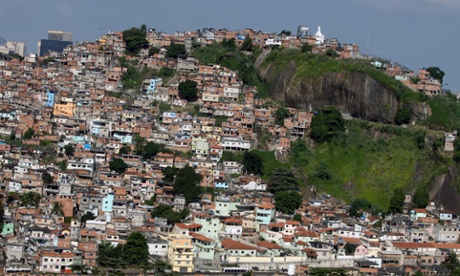
The Morro da Providencia favela rises above Rio de Janeiro's Copacabana and Ipanema beaches.Despite the looming World Cup and Olympics, constitutional reform and powerful drug lords have kept redevelopment of Rio’s squatter settlements at bay – but the price is poverty and anarchy 
 
The Morro da Providencia favela rises above Rio de Janeiro's Copacabana and Ipanema beaches. Photograph: Vanderlei Almeida/AFP/Getty Images
Violent protests broke out in a favela near Copacabana this month after a resident was killed in clashes with the army.
Violent protests broke out in a favela near Copacabana this month after a resident was killed in clashes with the army. Photograph: Christophe Simon/AFP/Getty
The granite hump of Providencia gazes down like a stern guardian on the old port of Rio de Janeiro. It offers probably the finest viewpoint over any city I know. Rio’s great bay stretches inland to distant mountains. Below lies what was once the world’s third largest port, now mostly silent. Along the coast a parade of beach resorts march to the foot of Sugar Loaf Mountain, with Copacabana and Ipamena hiding beyond. Over them all towers a range of steep rain-forested hills, crowned by the art deco beacon of Christ the Redeemer. The sight is breath-taking.
I was admiring this view from the top of the hill when I felt a hand tugging at my belt. In this city of muggers, and eager to avoid a scene, I moved quickly along the handrail, only to be alarmed when the hand came and resumed its grasp. I then noticed it belonged to a blind boy with severe disabilities. I had been blocking his only route home. It was a wretched scene amid that firmament of wonder.
In most cities, Providencia would be a Montmartre or Nob Hill, a luxury retreat above the city smoke. Yet it is Rio’s oldest favela, settled in 1897 by a group of returning war veterans. Its cheap houses remain to this day, mostly unserviced and stinking of sewage, inaccessible except by precipitous steps.
At the last count there were roughly 600 such “informal” communities, accommodating a quarter of the city's 6 million inhabitants. Over the past half century Rio’s centre of gravity has, as with many cities, drifted west from its original home. It now sprawls for over 20 miles of beaches and promontories, dramatically interspersed with mountains. Clinging to their slopes are squatter settlements, often lying immediately adjacent to rich districts “on the asphalt” below.
All developing cities – and most developed ones – have their slums. But Rio’s are remarkable in their ubiquity and in their survival in the same locations. While those on the flat can be reached by road, most are stacked on hillsides, hard to reach on wheels, flooded in storms and lacking sewerage and other public services. Until recently the favelas – named after scrub plants that once occupied them – were no-go areas for the police or government officials, and remained in thrall to feuding drugs gangs. They testify to the futility of criminalising the supply of what is a standard consumer product. The favelas are Blade Runner meets Italian hill town.
With the World Cup and Olympics looming, these places are testing Brazil’s civic conscience. Most cities would by now have contrived to clear such settlements, rehousing their inhabitants with varying degrees of compulsion elsewhere. The process can be seen from Mexico City to Lagos, from Johannesburg to Bangalore, or in London or Paris a century ago. Older areas are gentrified and this in turn draws tax revenue, private investment and political clout to deliver new urban infrastructure. Even in Rio this is happening to such historic central areas as Lapa and Santa Teresa, where old streets are starting to draw restaurants, shops and entertainment back to depressed quarters.
In Rio’s favelas, however, any such process has largely stalled. Their control by the drug lords kept all forms of government, including redevelopment, at bay, often at the point of a gun. A 1988 constitutional reform gave residents a degree of security of tenure, usually after five years of occupation, and title deeds are now reckoned to cover between a third and two-thirds of favela residents. Compulsory eviction supposedly requires local consultation and the availability of alternative housing near at hand.
Such security has not been totally effective, though. The Popular Committee for the World Cup and the Olympics, which has been behind recent protests against the football tournament, claims no fewer than 170,000 people are being removed from their homes for the games. But activists have held out against the sort of mass clearance experienced by British cities in the 1960s and 1970s and by Beijing before its Olympics. Rio has failed to remove the Vila Autódromo favela, which still stands defiantly by the fence of the new Olympic park.
For followers of post-modernism’s “new urbanism”, Rio is an exciting, infuriating place. As an urban form the favela is inherently robust, green and “sustainable”. It can offer high-density, low-cost living on locations penetrating the city centre and within reasonable reach of work. Its residents rely on walking and two-wheeled vehicles – taxis are ferocious motorbikes – creating close-knit, self-reliant communities in which ties of family and neighbour are strong. They delineate their own boundaries of loyalty and defensible space.
The 'pacified' favela of Cantagalo, which borders Pavão-Pavãozinho
The 'pacified' favela of Cantagalo. Photograph: Mario Tama/Getty
As a result the world flocks to study them. They have become intellectual works-in-progress to universities such as Pennsylvania, Columbia and the LSE. Pennsylvania even built its own campus “pop-up favela” for study purposes. A leading NGO champion, Theresa Williamson of Catalytic Communities, sees the favelas as the “ideal affordable housing stock”. Their buildings are mostly brick-built and sound, maximising every inch of space and fashioned to occupants’ needs. They are low-energy to a fault.
The challenge is somehow to upgrade them to meet even the minimal standards expected for modern urban living, without lurching into old-fashioned, state-sponsored clearance and renewal. It is the challenge of the “smart cities” movement. Rio’s authorities have long acknowledged the policy: Favela Bairro in the 1990s saw them as “civic assets” rather than “aberrations”. At its most basic, it secured the widespread concreting of alleys and stairways and introduced some sewerage. The theft of electricity was tolerated, through illicit wires that form a lethal canopy over back lanes.
Favela Bairro was assessed by the RioOnWatch website as having upgraded 168, or roughly a quarter, of the larger favelas by 2010. That year it was superseded by the Olympic “legacy” programme of Morar Carioca. Launched by the flamboyant mayor, Eduardo Paes, this allotted $4.5bn (£2.7bn) to achieve the complete “urbanisation” of the favelas by 2020. The city would be improved from the ground up and through “the participation of organised society … through assemblies and meetings in the communities”. In future, the favela would be seen not as Rio’s problem but “the solution … the visionary answer to how the world is going to deal with the third of humanity who will live in informal settlements by 2050”.
Morar Carioca was undeniably an imaginative exercise in sensitive urban renewal. Prepared with the Institute of Brazilian Architects , it would retrofit the city’s entire stock of low-cost housing, and do so free of the cost, misery and social disruption of traditional urban renewal. Houses would be left to their owners. The state would renew the public space round them.
The spirit of Morar Carioca lives, but those involved in it have been disappointed. A visit to the architects’ institute is a gloomy experience, as its president, Sergio Magalhaes, shuffles maps and plans from which one project after another has been removed. What had been “a special moment in mobilising the efforts, hopes and expectations of the people”, he says, had become merely an exercise in using the Olympics to direct investment to rich and expanding areas.
The Teleferico cable car system soars over the Alemão favela.
The Teleférico cable car system soars over the Complexo do Alemão favela in the north of the city. Photograph: Mario Tama/Getty Images
The promised investment has not been forthcoming, while government effort has been directed at favela “pacification”. Initiated in 2008, this rightly acknowledged that lasting improvement of favela living conditions required government control of law and order. Otherwise nothing would happen. This took the form of mass police incursions into one favela after another, driving the gang leaders out – even if they merely moved to others. The police then remained as a permanent presence. Favela police commanders would become, in effect, local mayors.
The programme has had its failures. Last week a police killing in the Pavão-Pavãozhino favela near Copacabana showed how easily the police can revert to old and brutal habits. The new police station in Alemão is reminiscent of Ulster’s fortified citadels during the troubles. They are hardly a sign of hearts and minds being won and have led the geographer and local blogger, Chris Gaffney, to describe it as having merely “replaced one arbitrary and militarised system of justice with another”. But killings in pacified favelas, by both police and gangs, have halved over the past five years. If pacification is not an end in itself it is the essential beginning of a process, the rule of some sort of law on which regeneration can proceed.
The trouble, as always, is the lack of resources for that regeneration. Brazil, like most modern political economies, is in thrall to mega-events. Glory lies in the grand gesture, the big scheme, the glamour project. Rio’s current pride and joy is the redevelopment of its disused port area, the Porto Maravilha project. An overhead motorway is being buried underground and a promenade laid out between the downtown and the water. Trump towers and a luxury hotel are to rise beside it. Historic 19th-century streets are being restored and an old slave dock uncovered. A curiously titled “museum of the future” designed by Santiago Calatrava is emerging on an old quay.
This is easy renewal, of a virtually empty zone of the old city. Nor has there been much attempt to repopulate it with socially mixed housing. An effort to clear a third of the adjacent favela of Providencia was balked by furious protests. A local hero, the artist Maurício Hora, campaigned against eviction by photographing threatened residents and projecting their faces on to their outside walls.
Providencia was eventually awarded not improved utilities but one of the more bizarre gestures of urban renewal I have seen. A heavily over-engineered $35m cable car runs just half way up its slope and then appears to have been abandoned. A similar contraption in London’s Docklands runs at barely 10% of capacity. Such investments are beloved of mayors, sponsors and contractors, but seldom of residents.
Brazilian artist Maurício Hora documented daily life in the Providencia favela.
Brazilian artist Maurício Hora has documented daily life in the Providencia favela. Photograph: Antonio Scorza/AFP/Getty Images
A longer cable car, meanwhile, carries a trickle of passengers over the roofs of the sprawling favela of Complexo do Alemão in north Rio. Its otherworldly structure, constantly moving cars and white-gloved attendants would seem more appropriate to a ski-lift in Gstaadt. It stops near few houses and is unavailable for heavy goods. A ground-level funicular would have made more sense.
Attempts to upgrade low-lying favelas are eerily reminiscent of similar British projects of the 1960s and 70s. I walked through what is left of Manguinhos with Leona Deckelbaum, a local housing official turned activist. It was old-fashioned federal slum redevelopment: regimented tenements gave on to desolate open spaces, with allotments and kiosks in which local people were expected to find work. While a library has been opened, most of the area was smashed and deserted, the kiosks unused.
Next door, across a no man's land of rubble, lay the remains of the surviving favela: a warren of lanes, alleys, workshops, bars, undrained and filthy. The place was regularly flooded by a polluted canal, but it was also a live community. “If only the money would have been spent just fitting drains and sewerage into the old favela,” Deckelbaum said. “But then, sewers do not look good at world urbanisation conferences – not like cable cars.”
The same lesson is evident on the outskirts of the city at Cidade de Deus. This was a state resettlement estate laid out in the 1960s and notorious as setting for the movie, City of God. It was built with only the most rudimentary infrastructure and left to run itself, which soon brought it under the aegis of drug gangs. With no government or planning and few public services, the area’s population grew to 70,000. Floors were added, yards were filled in, lanes disappeared. The original layout was swiftly obliterated. Cidade de Deus has recently been “pacified”. It yet could offer a better template of self-improved housing than a cluster of frigid municipal towers.
Yet that prospect for Rio has its own bugbears. After pacification, favelas adjacent to the coast such as Vidigal and Rocinha have seen rents and house prices surge, inviting complaints of gentrification. “Favela chic” has entered the language. TripAdvisor exults over “authentic eco-friendly favela” tours. Rocinha has coffee and sushi bars. A guest-house hotel on the summit of Vidigal has a view to rival any on the Côte d’Azur, even if it is desperate to reach. Hip restaurants and alternative bed-and-breakfasts are appearing on the back of discreet coach tours.
A boy rides a bike with no tires in the Complexo da Mare favela, which is being occupied by federal troops ahead of the World Cup.
A boy rides a bike with no tires in the Complexo da Mare favela, which is being occupied by federal troops ahead of the World Cup. Photograph: Mario Tama/Getty
This presents Rio with the classic urban paradox. The superb location of many favelas gives them immense imputed value from gentrification and tourism, value that in most cities would have long drawn to them new residents, employers and investors. They in turn would have generated resources for better services.
Yet favelas are proud places whose residents enjoy a measure of security of tenure and a growing civic confidence. “We want to be happy and walk freely in the favela where we were born,” states a protest banner in Manguinhos. Another at Vila Autódromo boasts “a peaceful and orderly neighbourhood since 1967”. As these places are upgraded and made secure, there is an inevitable impact on their desirability and price – and on the desire of some residents to realise such assets as they have and move elsewhere.
All forms of social housing sooner or later must grapple with rights of property transfer. A federal proposal to build 2,200 social housing units in the new Porto Maravilha was challenged by Rio’s mayor, Eduardo Paes, on the grounds that their residents would just sell them. “Don’t come to me with laws telling them they cannot sell,” he told a recent conference, “because they do it … everybody sells their house.” While state-run estates, condominiums and co-operatives can impede this, the implied legal control is a far cry from a Rio favela. Besides, the essence of the favela sovereignty is local ownership.
Any visitor to Rio’s poorer districts sees a glaring conflict between the chronic need for investment and the frozen value of the land. People want services “from the ground up”, yet are sceptical of the necessary resources being generated by their own rents and taxes – even if it were to mean new residents, investment in infrastructure, jobs and civic clout. They see gentrification leading to evictions, even where the residents themselves would benefit from property sales. Their default is to see the state as responsible for retrofitting their communities.
All urban renewal is a conflict between social geography and the market for land. Since the 1980s, Rio’s favelas have “traded” a degree of security of low-cost tenure for dreadful living conditions and crime-ridden governance. The constitutional “right to occupy” a particular plot of land has been at the price of zero investment, poverty and anarchy. The freedom to stay put implies bondage, if it means being unable to up sticks and move, taking the value of one’s home with one. Paes himself recognises this, and is reluctant to control the housing market and become “the Fidel Castro of the favelas”.
Life in the Cantagalo favela, near Copacabana.
Life in the Cantagalo favela. Photograph: Tasso Marcelo/AFP/Getty Images
The favelas are thus a test bed of every tenet of modern urban renewal. They are defended by new urbanists as the social housing stock of the future. But if they remain static communities, they will never see the investment they sorely need. Their aspiring and enterprising young will leave in search of more salubrious living quarters, while their parents stay, as in urban ghettos the world over, prisoners of an archaic poverty.
Rio’s favelas may entrance academics as sustainable informal housing, but academic fashion builds no drains, pipes, schools or clinics. Letting the property market rip is clearly not acceptable, and can be as traumatic to a community as were the mass slum clearances of the 20th century. But there has to be a compromise between gentrification and stasis. Somewhere in a freer residential property market lie the resources to update these places.
Favelas are exciting as a remarkable surviving pattern of urban living. A vision, sensitive and workable, is in place for their renewal. But Rio is still searching for a way to implement it.
Simon Jenkins: the World Cup and Olympics threaten to overwhelm Rio

Rosewood